- Nurses
- Students
- Educators
Fields of nursing
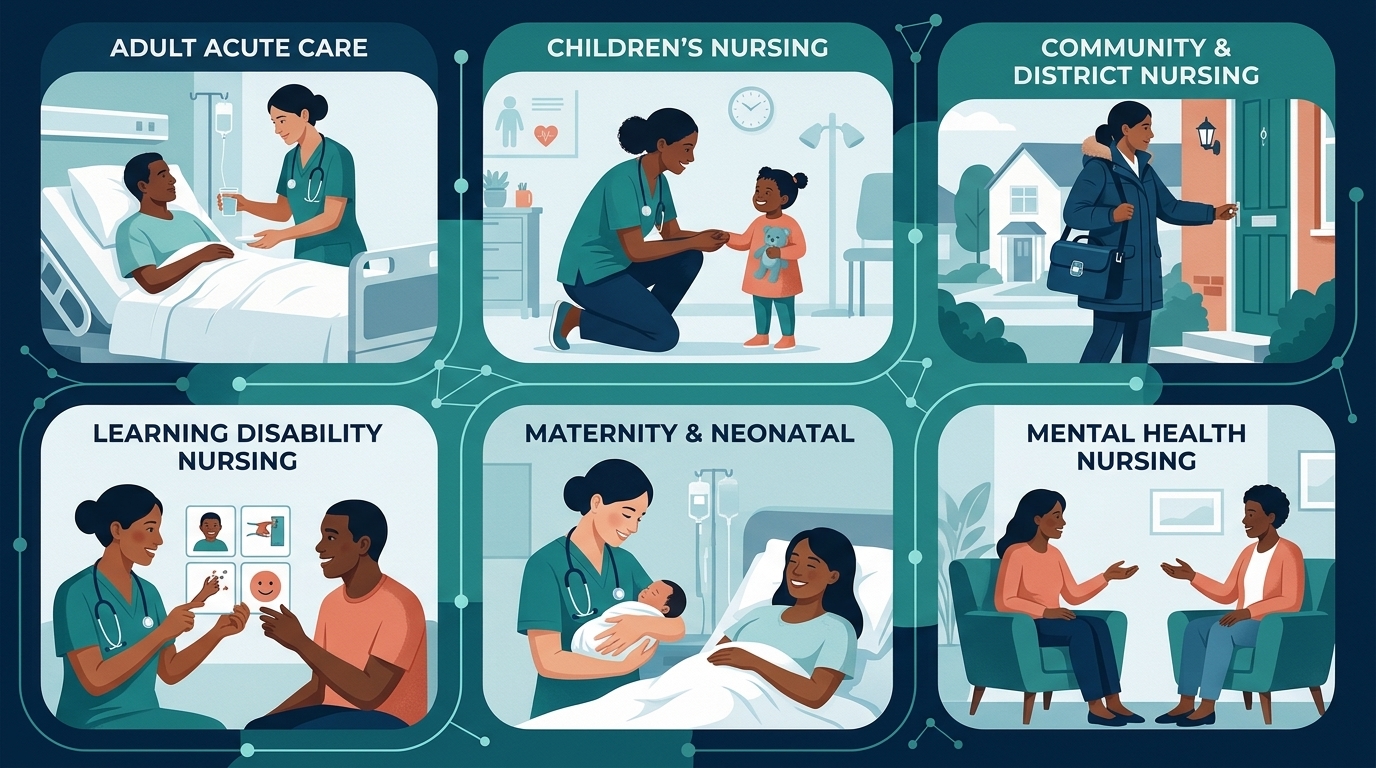
Most AI guidance is written as if all care were the same. It isn't. The same tool can be low-risk on a surgical ward and high-risk in a secure mental health unit, helpful for a person who prefers to listen and harmful for a person who can't consent to being recorded.
These pages look at AI through the lens of each field of nursing.
Explore your field of practice
Compare Consent Complexity, Error Cost & Red Lines Across All Six Nursing Fields
Select a field of practice to inspect how clinical context changes what AI can safely support and where the sharpest boundaries sit.
Adult Nursing (Acute, Surgical & Long-Term Care)
Adult nursing
Acuity, deterioration, sepsis alerts, polypharmacy, and safe discharge communication across acute and long-term care.
Children & young people
Gillick competence, parental and child consent, age-appropriate explanations, safeguarding, and paediatric dosing red lines.
Community & district
Ambient recording in people's homes, lone working, personal vs trust devices, and family carer involvement.
Learning disability
Mental Capacity Act, diagnostic overshadowing, speech recognition bias, and co-checked Easy Read information.
Maternity & neonatal
Perinatal equity, listening to women and birthing people, pulse oximetry and skin tone bias, and sensitive bereavement care.
Mental health nursing
Therapeutic alliance, AI scribes in distress or psychosis, Mental Health Act detention, and avoiding stigmatising language.
Summary of highest-risk areas by field
| Field | Highest-risk areas |
|---|---|
| Adult nursing | Deterioration, sepsis, medicines, discharge |
| Children and young people's nursing | Consent and Gillick competence, safeguarding, children's data |
| Community and district nursing | Recording in homes, personal devices, lone working |
| Learning disability nursing | Consent and capacity, speech recognition, easy read |
| Maternity, neonatal and family care | Inequalities, sensitive information, being listened to |
| Mental health nursing | AI scribes, stigmatising language, risk, detention |
Questions to ask in any field
- Who might this tool work less well for here? Think about communication, capacity, language, age and disability.
- What is the cost of an error here? It is higher where people are less able to notice or challenge a mistake.
- What does consent look like here? Think about capacity, fluctuating capacity, detention, children, and people who find it hard to say no.
- What does the field's own guidance say? Check specialist and professional body guidance as well as general AI policy.
The Copilot prompt explorer includes a prompt for each field of nursing. Filter by "Fields of nursing".