The nursing process
- Nurses
- Students
- Educators
- NMC platform 4
Implement
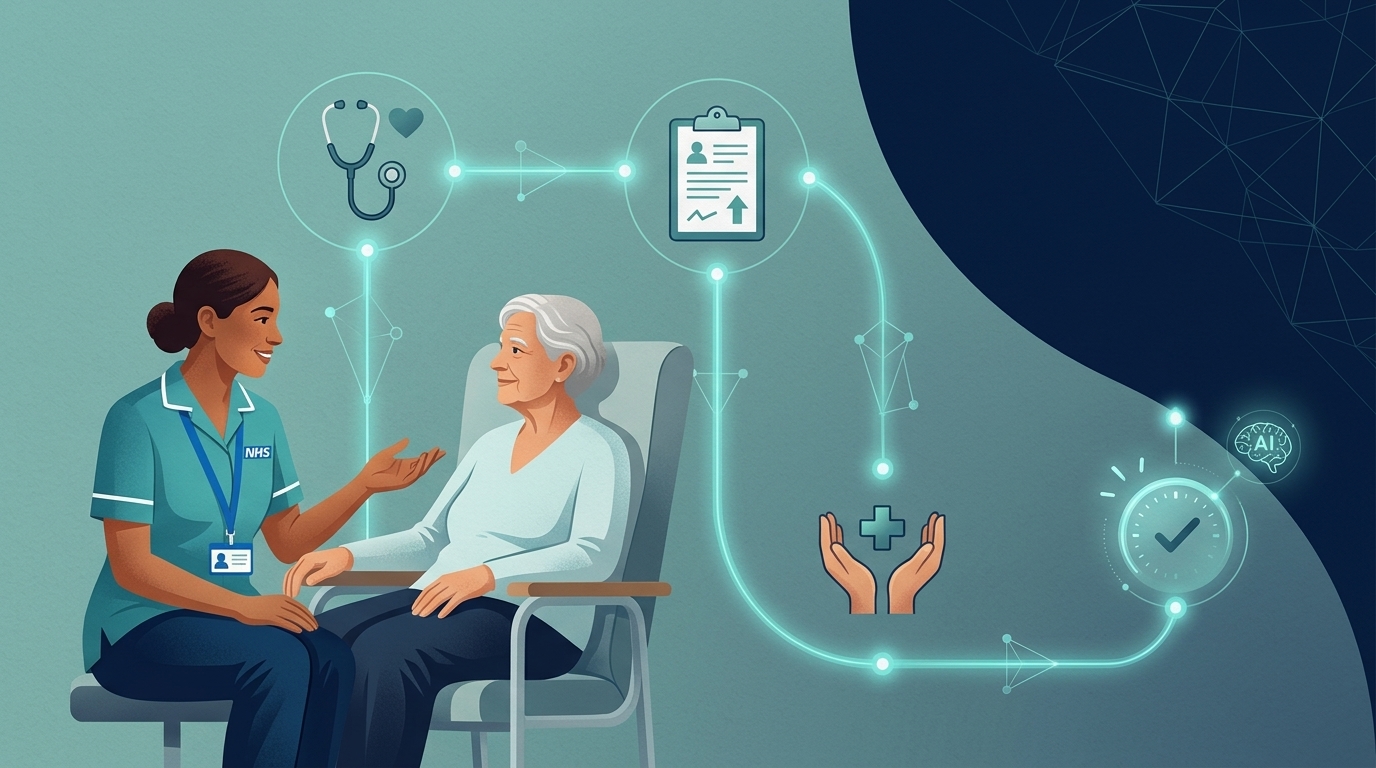
Care in action — procedures, medicines, communication and education, where AI should stay furthest in the background.
Preparation, not presence — accessible information, rehearsing difficult conversations and structuring handover from your own notes.
Every clinical line — doses and procedures come from authoritative sources, and understanding is confirmed with teach-back.
Implementation is care in action: procedures, medicines, communication, education and coordination. It's where the relationship between nurse and person matters most, and where AI should stay furthest in the background.
Where AI helps vs. where it can cause harm
- Accessible information: AI can draft easy-read versions, different reading levels or translations for a person to take away. Translations of clinical information still need checking by a qualified interpreter or an approved service.
- Explaining how things work: Visual explanations can support patient education. See Medication mechanisms and Wound care visualisation.
- Rehearsing a difficult conversation: Practise breaking bad news or responding to distress before the real thing. See Difficult conversations.
- Handover and coordination: Approved tools can help structure handover information, such as SBAR, from your own notes.
- Clinical errors in leaflets and explanations: Doses, contraindications and procedures must come from authoritative sources, not from AI.
- Losing presence: If a screen sits between you and the person, the care is diminished, however efficient it feels.
- Accessibility done badly: A machine translation or easy-read version can be confidently wrong. Test it with the people it is for.
Looking through the lenses
Person-centred practice
Am I being sympathetically present, or is the technology taking my attention?
Ways of knowing
Does this explanation feel right for this person in this moment? That's aesthetic knowing.
Novice to expert
A student uses AI to rehearse and prepare. An experienced nurse uses it sparingly, and only where it frees time for the person.
Theoretical and regulatory underpinnings of implementation (1952–2026)
Implementation is where nursing care is experienced directly by the person—through touch, clinical skill, spoken reassurance, and accessible education. Nursing theory and 2020–2026 AI ethics define strict boundaries between preparatory tasks where AI can help and relational bedside care where human presence is irreplaceable.
Interpersonal Relations & Sympathetic Presence
Hildegard Peplau (1952, Interpersonal Relations in Nursing) and McCormack & McCance (2006, 2021, 2025) show that the therapeutic nurse–patient relationship is itself a clinical intervention. During implementation, technology must stay in the background so sympathetic presence is never displaced by a screen.
Ethics of Caring & Task Division
Stokes & Palmer (2020, Nursing Philosophy) and Locsin (2005, 2017) argue from Tronto’s feminist ethics of care that AI may assist with preparatory or logistical sub-tasks (drafting a plain-English handout, structuring an SBAR handover), but must never replace relational acts of caring, comforting, or breaking difficult news.
Cognitive Load, Health Literacy & Teach-Back
Drawing on Cognitive Load Theory (Sweller, 1988) and the NHS Health Literacy Toolkit (2020–2026), AI can help reduce extrinsic cognitive load by simplifying approved clinical text to reading age 9–11. However, nurses must always verify every clinical line and confirm patient understanding using teach-back.
Accessible Information Standard (DAPB1605)
Under the statutory NHS Accessible Information Standard (DAPB1605, revised 2025), services must identify, record, flag, share, meet, and review communication needs. AI can help draft Stage 5 Easy Read or plain-language materials, but never replaces co-production or a qualified spoken or BSL interpreter for clinical care and consent.
Safe Handover & SBAR Communication
Aligned with the NHS Patient Safety Syllabus (2021–2026) and NMC Platform 4, structured communication tools (such as SBAR) reduce handover omissions. If an approved enterprise AI tool helps format handover notes, the nurse must verify that acute deterioration triggers, allergies, and resuscitation status are preserved verbatim.
NMC Platform 4 & Annexe A Communication
NMC Future Nurse Platform 4 and Annexe A require nurses to use evidence-based communication, de-escalation, and safe procedural skills. Students can use voice AI with synthetic personas to rehearse difficult conversations before placement, building confidence without risking patient harm.
Evolution of implementation theory and AI safety (1952–2026)
Go deeper: full milestone table with sources (5 rows)
| Year / Period | Key Scholars / Standard | Core Implementation Principle | Application to AI in Implementation Today |
|---|---|---|---|
| 1952 | Peplau (Interpersonal Relations in Nursing) | Nursing is an educative, therapeutic interpersonal process between nurse and person | Use AI before or after the encounter so your full attention remains with the person at the bedside |
| 1988–2024 | Sweller (1988); NHS Health Literacy & Teach-Back Guidance | Reduce unnecessary cognitive load in patient education and confirm comprehension via teach-back | Ground plain-English prompts strictly in approved UK leaflets, verify every red flag, and check understanding in person |
| 2005–2020 | Locsin (2005, 2017); Stokes & Palmer (2020) | Divide tasks using caring ethics: AI supports logistics; nurses lead relational and moral care | Never delegate breaking bad news, distress support, or therapeutic reassurance to an automated avatar or chatbot |
| 2016–2025 | NHS Accessible Information Standard (DAPB1605, revised 2025) | Six-stage statutory duty to meet communication and information needs | Co-produce Easy Read checks with service users and always book a qualified interpreter for clinical consultations |
| 2018–2026 | NMC Platform 4 & Annexe A; NHS Patient Safety Syllabus | Safe, evidence-based interventions and structured clinical handovers (SBAR) | Rehearse communication skills with synthetic AI personas and verify all SBAR handover summaries against the clinical record |
Try it
Rewrite this explanation of how to use an inhaler at a reading age of about 9.
Keep every step, in the same order. Don't add any clinical advice.
Then list anything a nurse should check before giving it to a patient.
[paste your own explanation]
When using an approved AI tool to simplify a discharge leaflet into plain English (reading age 9) for a patient and their carer, which rule is essential during the Implement stage?
Related pages
Reading
- Peplau, H.E. (1952) Interpersonal Relations in Nursing: A Conceptual Frame of Reference for Psychodynamic Nursing. New York: G.P. Putnam's Sons.
- Sweller, J. (1988) Cognitive load during problem solving: effects on learning. Cognitive Science, 12(2), pp. 257–285.
- Stokes, F. and Palmer, A. (2020) Artificial intelligence and robotics in nursing: ethics of caring as a guide to dividing tasks between AI and humans. Nursing Philosophy, 21(4), e12306.
- NHS England (2025) Accessible Information Standard (DAPB1605: Amd 36/2025). London: NHS England.
- Nursing and Midwifery Council (2018, updated 2024) Future nurse: Standards of proficiency for registered nurses (Platform 4 and Annexe A). London: NMC.