The nursing process
- Nurses
- Students
- Educators
- NMC platform 3
- NMC platform 4
AI through the nursing process
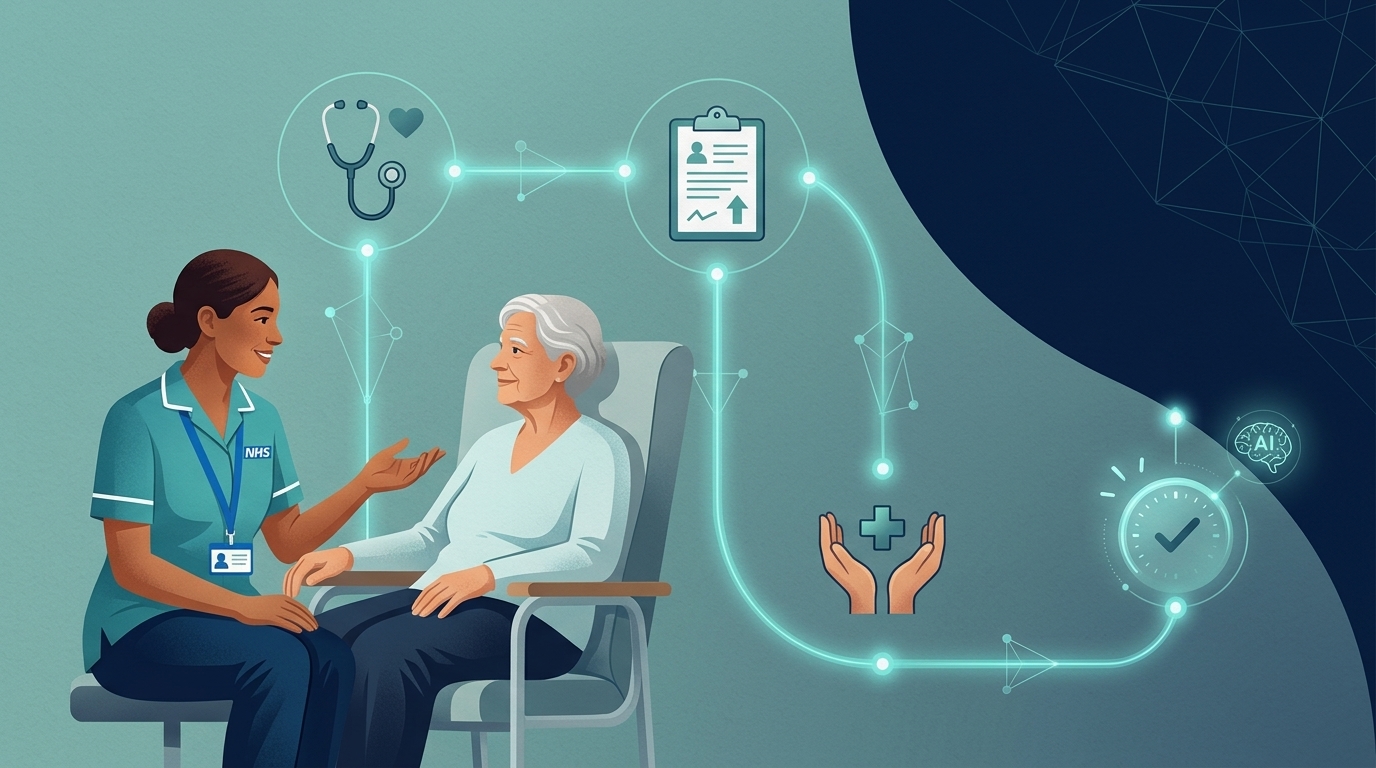
Nurses already have a way of thinking about care: assess, plan, implement, evaluate. This toolkit uses the same four stages to think about AI. At each stage it asks two questions:
- Where could AI genuinely help? For example, by saving time, making information clearer or prompting a question you might not have asked.
- Where could it cause harm? For example, by missing something, inventing something, flattening a person into a category, or tempting you to skip your own judgement.
The nursing process is a cycle, not a checklist. AI doesn't change that. Whatever a tool produces at one stage feeds the next, so an error at assessment can travel all the way into the care you give. Checking at every stage is what keeps the cycle safe.
Some textbooks, mainly in North America, add a separate diagnosis stage (ADPIE). UK practice and the NMC proficiency platforms usually describe the cycle as assessing needs and planning care (platform 3) and providing and evaluating care (platform 4). Either way, the logic of this toolkit is the same.
Interactive APIE Cycle & Error-Cascade Simulator
Explore the Four Stages or Trace How an Unchecked AI Error Cascades
Switch between the 4-Stage APIE Wheel and the AI Error-Cascade Simulator to see why human verification is needed at every transition.
Click A, P, I, or E on the wheel
Stage 1: Assess (Orlando (1961) · Roper, Logan & Tierney (2000) · Tanner (2006))
NMC Platform 3 · Code 5, 10, 13Core nursing question: What is happening for this person, and what matters to them?
Explore the four stages
Assess
Question: What is happening for this person, and what matters to them?
AI role: Structuring notes, ambient scribes, prompting history questions.
Plan
Question: What are we aiming for together, and how?
AI role: Drafting goals to edit, checking person-centred language.
Implement
Question: How do we deliver care and communicate well?
AI role: Accessible patient leaflets, rehearsing difficult conversations.
Evaluate
Question: Did it work, and what have we learned?
AI role: Summarising audit themes, scaffolding clinical reflection.
The four stages at a glance
| Stage | The nursing question | How AI might help | The main risk |
|---|---|---|---|
| Assess | What is happening for this person, and what matters to them? | Structuring information, transcribing a conversation, prompting questions to ask | Missing or misheard information, and data protection at the point of collection |
| Plan | What are we aiming for together, and how? | Drafting goals and options for you to edit, checking a plan reads in plain language | Generic plans that don't belong to the person |
| Implement | How do we deliver care and communicate well? | Patient information in accessible formats, rehearsing a difficult conversation | Wrong or out-of-date clinical content, and loss of human presence |
| Evaluate | Did it work, and what have we learned? | Summarising audit data, supporting reflection | Accepting AI's verdict on quality without checking it |
Three lenses on every stage
Each stage page also looks at AI through three nursing lenses. They're explained in Nursing lenses:
- Person-centred practice: does this use of AI keep the person, and their values, at the centre?
- Ways of knowing: AI offers knowledge that looks evidence-based. What do ethical, personal, aesthetic and emancipatory knowing add?
- Novice to expert: what does safe use look like for a student, and what does it look like for an experienced nurse?
Theoretical and historical underpinnings of the nursing process (1955–2026)
The four-stage Assess, Plan, Implement, Evaluate (APIE) cycle is not merely an administrative workflow; it is a dynamic, relational, and safety-critical clinical reasoning framework refined over seven decades of nursing scholarship. Understanding its theoretical roots explains why inserting unverified AI into any stage of the cycle can propagate errors downstream.
Deliberative & Relational Origins
Lydia Hall (1955) first described nursing as a distinct process, and Ida Jean Orlando (1961, The Dynamic Nurse-Patient Relationship) showed that safe nursing action depends on validating perceptions directly with the patient rather than acting on automatic assumptions—the exact antidote to unverified AI output.
The Four-Stage APIE Cycle
Helen Yura and Mary B. Walsh (1967, The Nursing Process) formalised the four cyclic stages still used across UK nursing today: Assessing, Planning, Implementing, and Evaluating—establishing that evaluation continuously feeds back into reassessment.
UK Activities of Living & Holistic Assessment
Nancy Roper, Winifred Logan and Alison Tierney (1980, 2000) anchored the nursing process in UK practice through the Model of Nursing Based on Activities of Living, situating every assessment and care plan across biological, psychological, sociocultural, environmental, and politico-economic factors.
Clinical Judgement & Person-Centred Integration
Tanner (2006) and McCormack & McCance (2006, 2021, 2025) cautioned against treating APIE as a linear tick-box exercise, integrating clinical judgement (Noticing, Interpreting, Responding, Reflecting) and shared decision-making into every stage of the cycle.
NMC Future Nurse Platforms 3 & 4
The NMC Standards of Proficiency for Registered Nurses (2018, updated 2024) embed the cycle into statutory UK regulation via Platform 3 (Assessing needs and planning care) and Platform 4 (Providing and evaluating care), requiring evidence-based, person-centred judgement throughout.
Sociotechnical APIE & Error Cascade Prevention
Under NHS clinical safety standards (DCB0129/DCB0160) and NHS England Ambient Voice guidance (2025–2026), each APIE transition acts as a mandatory human-in-the-loop safety gate so an AI transcription omission at Assessment cannot cascade into an unsafe Plan or Implementation.
Evolution of the nursing process: from 1955 to 2026 AI governance
Go deeper: full milestone table with sources (5 rows)
| Year / Period | Key Scholars / Standard | Core Contribution | Role in Safe AI Nursing Practice |
|---|---|---|---|
| 1955–1961 | Hall (1955); Orlando (1961) | Introduces the deliberative nursing process: validating patient distress and meaning before acting | Prevents nurses from acting on unverified AI summaries without checking directly with the person |
| 1967 | Yura & Walsh (The Nursing Process) | Formalises the four-stage Assess, Plan, Implement, Evaluate (APIE) cycle | Provides the four-stage clinical spine of this toolkit and the NCD Prompt Pattern |
| 1980–2000 | Roper, Logan & Tierney (The Elements of Nursing) | Integrates 12 Activities of Living and five lifespan/contextual dimensions into UK APIE care planning | Guards against generic AI care plans that ignore sociocultural, environmental, or individual dependence/independence factors |
| 2006–2025 | Tanner (2006); McCormack & McCance (2006, 2021, 2025) | Connects APIE to situated clinical judgement and person-centred practice | Ensures AI supports—rather than replaces—relational assessment, shared goal-setting, and reflective evaluation |
| 2018–2026 | NMC Future Nurse Standards (2018, updated 2024); NHS England (2025–2026); DHSC (2026) | Statutory UK proficiency structure (Platforms 3 & 4) paired with DCB0160 clinical safety and human-in-the-loop review | Requires explicit clinician verification at every APIE stage so algorithmic errors never reach bedside care |
Ground rules that apply at every stage
- Use only tools your organisation or university has approved, and only for the purposes they're approved for.
- Never enter information that could identify a patient, family member or colleague into a tool that isn't approved for it.
- You remain accountable. Anything AI drafts becomes your work when you use it. See The NMC Code review and AI.
- Check against an authoritative source, such as NICE, the BNF or local policy, before acting on any clinical content.
Reading
- Orlando, I.J. (1961) The Dynamic Nurse-Patient Relationship: Function, Process and Principles. New York: G.P. Putnam's Sons.
- Yura, H. and Walsh, M.B. (1967) The Nursing Process: Assessing, Planning, Implementing, Evaluating. Washington, DC: Catholic University of America Press.
- Roper, N., Logan, W.W. and Tierney, A.J. (2000) The Roper-Logan-Tierney Model of Nursing: Based on Activities of Living. Edinburgh: Churchill Livingstone.
- Tanner, C.A. (2006) Thinking like a nurse: a research-based model of clinical judgment in nursing. Journal of Nursing Education, 45(6), pp. 204–211.
- Nursing and Midwifery Council (2018, updated 2024) Future nurse: Standards of proficiency for registered nurses (Platforms 3 and 4). London: NMC.