- Nurses
- Students
- Educators
- Programme leads
- Practice development leads
- NMC platform 1
- NMC platform 7
Equity and AI
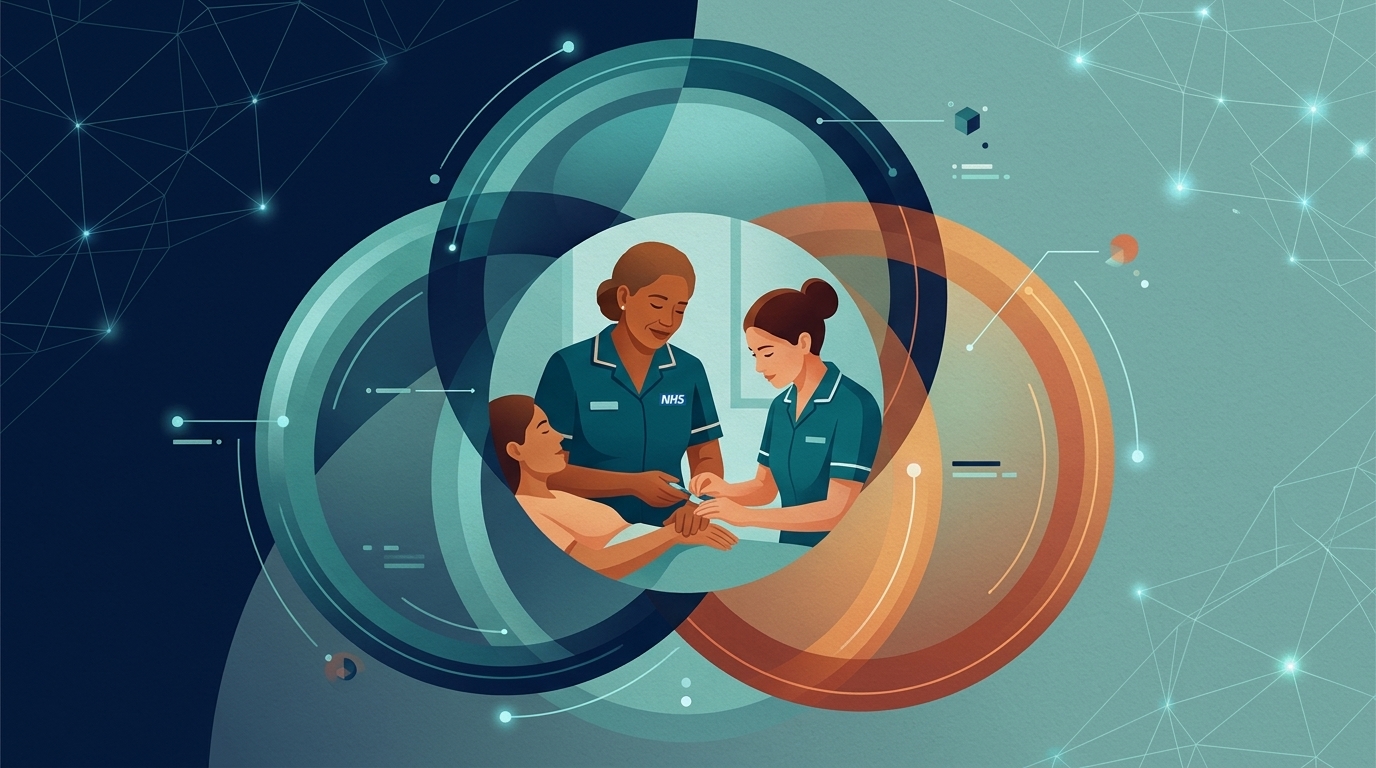
AI learns from the past, and the past isn't fair. Health data reflects who has been seen, measured, believed and funded. When technology is built on that data without care, it can reproduce inequalities, or make them worse, while appearing neutral.
This page puts emancipatory knowing (see Ways of knowing) into practice: noticing whose interests a technology serves, who it fails, and acting on it.
Unequal historical records, unrepresentative training images, and flawed proxies (such as past healthcare spend instead of clinical need).
Trust the person over the device: if a score, oximeter reading, or AI transcript contradicts what you see and hear, escalate on clinical judgement.
Under the Public Sector Equality Duty (Equality Act 2010, s.149), trusts and universities must assess and monitor AI impact across groups.
What the evidence shows
Inspect Five Documented Ways Health AI & Devices Create Inequality
Select an evidence domain to see how bias enters the technology, what nurses do at the bedside, and what NHS/university governance must check.
Pulse Oximeters & Optical Skin-Tone Bias
DHSC Equity in Medical Devices Review (2024)| Example | What was found | Source |
|---|---|---|
| Pulse oximeters | Can overestimate oxygen levels in people with darker skin tones more than in people with lighter skin, risking missed or delayed treatment. The UK government accepted all 18 recommendations of the independent review, including on AI. | Equity in Medical Devices: Independent Review, 2024 |
| A population health algorithm | A widely used US algorithm used past healthcare spending as a stand-in for need. Because less had been spent on Black patients with the same needs, it judged them healthier, and fewer were flagged for extra care. Predicting need directly largely removed the bias. | Obermeyer, Z. et al. (2019) Science, 366(6464), pp. 447–453 |
| Speech recognition | Five commercial speech recognition systems made almost twice as many errors for Black speakers as for white speakers (average word error rate 0.35 against 0.19). | Koenecke, A. et al. (2020) PNAS, 117(14), pp. 7684–7689 |
| Chatbots and race-based medicine | Four large language models, asked medical questions, each repeated at least one debunked race-based claim, for example about kidney function. | Omiye, J.A. et al. (2023) npj Digital Medicine, 6, 195 |
| Clinical images | Teaching materials have relied on images of white skin, so signs on Black and brown skin are missed. AI image tools trained on similar material can repeat the gap. | Mukwende, M., Tamony, P. and Turner, M. (2020) Mind the Gap, St George's, University of London |
The same patterns can affect people by disability, age, sex and gender, language, neurodivergence, class and where they live. They are harder to see when the people affected aren't involved in designing, testing or reviewing the technology.
Why it matters for nurses
- You are often the person who notices. Nurses see when a tool works badly for a particular person: a reading that doesn't fit the person in front of you, a transcript that garbles someone's words, a leaflet that assumes a family that isn't there.
- The Code expects it. Treat people as individuals and uphold their dignity (standard 1), and treat people fairly and without discrimination (standard 20).
- Organisations have legal duties. Under the Public Sector Equality Duty (Equality Act 2010, section 149), public bodies must have due regard to eliminating discrimination and advancing equality of opportunity. That includes when they buy and use AI.
What nurses can do
Trust the Person Over the Device
If a reading, risk score, or AI transcript contradicts what you see and hear, escalate on your clinical judgement and log speech or skin-tone performance failures via Datix/LFPSE.
Ask for the EqIA
Request the Equality Impact Assessment (EqIA) before any AI tool goes live, involve patient/carer and staff networks early, and monitor outcomes disaggregated by group.
Teach with Diverse Cases
Pair AI diagrams with resources like Mind the Gap, and use biased AI outputs in Spot the error exercises to build emancipatory knowing.
Questions to ask about any AI tool
5 Questions to Ask Before & After Deploying an AI Tool
1. Training & testing representation:
   Whose data was this tool trained and tested on? Does that include people with the skin tones, accents, languages, ages, and disabilities of the people we care for?

2. Disaggregated performance:
   How does the tool perform across different protected characteristics, and who has independently verified those error rates?

3. Failure impact:
   What happens clinically when the tool gets it wrong, and which patients or families are most likely to be harmed or delayed?

4. Co-design & voice:
   Which patients, carers, and frontline nursing staff (including inclusion networks) were involved in deciding to buy or deploy it?

5. Post-deployment monitoring:
   How will we audit outcomes by group after go-live to detect if the tool is widening inequalities?
During a community visit, an approved ambient AI scribe produces a draft note that repeatedly misattributes and omits key symptom descriptions spoken by a patient with dysarthria and a strong regional accent. What should the nurse do?
Further reading
- Department of Health and Social Care (2024) Equity in Medical Devices: Independent Review, final report, and the government response.
- Koenecke, A. et al. (2020) Racial disparities in automated speech recognition. Proceedings of the National Academy of Sciences, 117(14), pp. 7684–7689. doi:10.1073/pnas.1915768117.
- Obermeyer, Z. et al. (2019) Dissecting racial bias in an algorithm used to manage the health of populations. Science, 366(6464), pp. 447–453. doi:10.1126/science.aax2342.
- Omiye, J.A. et al. (2023) Large language models propagate race-based medicine. npj Digital Medicine, 6, 195. doi:10.1038/s41746-023-00939-z.
- NHS Race and Health Observatory.