The nursing process
- Nurses
- Students
- Educators
- NMC platform 3
Plan
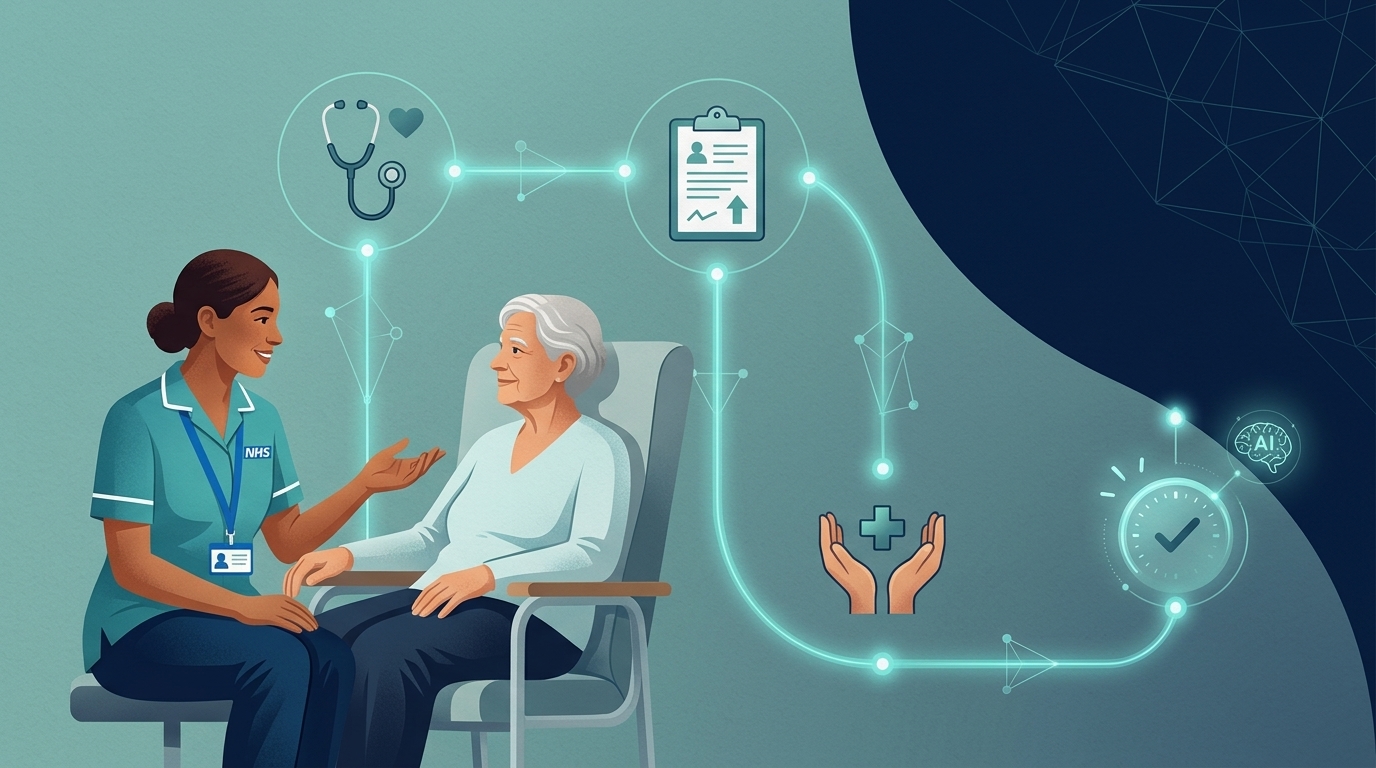
Turning assessment into shared goals — a good plan belongs to the person and reflects their priorities and words.
A first draft to edit — drafting goals from anonymised notes, plain-language rewrites and checking what a plan has missed.
Agree it with the person — check every intervention against current guidance and watch for generic or biased suggestions.
Planning turns assessment into shared goals and agreed actions. A good plan belongs to the person: it reflects their priorities, their words and the life they want to get back to.
Where AI helps vs. where it can cause harm
- A first draft to edit: From your own anonymised summary, AI can draft goals and interventions in a structure you recognise. Treat it as raw material, not as the plan.
- Plain language: AI can rewrite a plan so the person and their family can read it, and flag jargon. See Person-centred language.
- Options to discuss: AI can list approaches to a goal, such as different ways to manage pain at home, for you to explore with the person.
- Checking completeness: You can ask what a plan has not addressed, for example social circumstances, carers or communication needs.
- Generic plans: AI drafts tend towards the average patient. A plan that could belong to anyone belongs to no one.
- Outdated or wrong interventions: Check every clinical action against current guidance and local policy.
- Hidden bias: Training data reflects existing inequalities. Watch for assumptions about age, ethnicity, disability, gender or class in what AI suggests or leaves out.
- Shared decision-making skipped: A polished draft can make a plan feel finished before the person has had a say.
Looking through the lenses
Person-centred practice
Are the goals in the person's words, and did they help shape them?
Ways of knowing
Is this plan ethically sound for this person, as well as evidence-based?
Novice to expert
A student compares the draft against a care-planning framework. An experienced nurse asks what this particular person would push back on.
Theoretical and regulatory underpinnings of care planning (1967–2026)
Care planning is where clinical evidence meets a person's biography, values, and daily life. Nursing theory and UK healthcare law explain why an AI-generated care plan can only ever be an unverified starting point—never a substitute for co-production and shared decision-making.
Individualised Goals vs Generic Templates
Yura & Walsh (1967) and Roper, Logan & Tierney (1980, 2000) established that care planning must be tailored to each person’s individual position on the dependence–independence continuum. Because large language models predict the statistical average of their training data, unedited AI plans regress toward generic, depersonalised targets.
Shared Decision-Making & Montgomery
Under Montgomery v Lanarkshire Health Board [2015] UKSC 11 and NICE NG197 (2021, Shared decision making), clinicians must discuss options, risks, and benefits that are material to this particular person. An AI draft cannot know what risk or lifestyle trade-off matters most to the patient in front of you.
Working with Patients’ Beliefs & Values
McCormack & McCance (2006, 2021, 2025) place working with the person’s beliefs and values and sharing decision-making at the core of person-centred processes. A plan only becomes person-centred when co-authored with the person in language they recognise as their own.
Fundamentals of Care Integration
Kitson et al. (2013, 2021–2026) show in the Fundamentals of Care Framework that safe planning must weave together physical needs (hydration, mobility, skin integrity), psychosocial dignity, and the nurse–patient relationship—preventing AI templates from reducing care plans to disconnected task checklists.
Guarding Against Algorithmic Bias in Plans
Omiye et al. (2023) and Jabbour et al. (2023) show that generative models and clinical algorithms can reproduce cultural stereotypes or omit reasonable adjustments required under the Equality Act 2010. Emancipatory knowing requires checking what an AI draft assumes about family support, housing, diet, or finances.
NMC Platform 3 & MHRA SaMD Boundaries
Under NMC Future Nurse Platform 3 and MHRA Software as a Medical Device (SaMD) rules (2026), general-purpose AI tools are not regulated to recommend patient-specific treatments or doses. Every clinical intervention in a care plan must be verified against current NICE, BNF, and local trust policy.
Evolution of care-planning theory and AI governance (1967–2026)
Go deeper: full milestone table with sources (5 rows)
| Year / Period | Key Scholars / Standard | Core Planning Principle | Application to AI in Care Planning Today |
|---|---|---|---|
| 1967–2000 | Yura & Walsh (1967); Roper, Logan & Tierney (2000) | Individualised planning based on the person's dependence–independence continuum and lifespan context | Rewrite any generic AI draft so goals reflect the person's actual baseline, home setting, and priorities |
| 2006–2025 | McCormack & McCance (2006, 2021, 2025) | Working with the person's beliefs and values and sharing decision-making | Express care plan goals in the person's own words ("I want to...") rather than institutional jargon ("Patient will...") |
| 2013–2026 | Kitson et al. (Fundamentals of Care Framework) | Integration of physical, psychosocial, and relational care within a single plan | Check that AI-structured drafts do not strip out emotional support, communication adjustments, or relational presence |
| 2015–2021 | Montgomery v Lanarkshire [2015]; NICE NG197 (2021) | Shared decision-making grounded in what matters to the individual patient | Use AI only to prepare plain-language options beforehand; agree the actual care plan in dialogue with the person |
| 2023–2026 | Omiye et al. (2023); NMC Code Standards 1, 2, 6; MHRA (2026) | Evidence-based, equitable care planning free from algorithmic stereotyping or unverified clinical advice | Verify every clinical intervention against NICE/BNF and audit drafts for cultural, socioeconomic, or disability bias |
Try it
Here is an anonymised summary of a person's needs and what matters to them:
[summary, with no identifying details]
Draft three goals written in the first person, as the person might say them.
For each goal, list questions I should ask them before agreeing it.
You use an approved AI tool to help structure a draft care plan from anonymised notes. The draft returns three neat, measurable goals written in standard clinical phrasing ('Patient will mobilise 10m twice daily'). What must happen before this becomes the care plan?
Related pages
Reading
- Yura, H. and Walsh, M.B. (1967) The Nursing Process: Assessing, Planning, Implementing, Evaluating. Washington, DC: Catholic University of America Press.
- Roper, N., Logan, W.W. and Tierney, A.J. (2000) The Roper-Logan-Tierney Model of Nursing: Based on Activities of Living. Edinburgh: Churchill Livingstone.
- Montgomery v Lanarkshire Health Board [2015] UKSC 11.
- National Institute for Health and Care Excellence (2021) Shared decision making (NICE Guideline NG197). London: NICE.
- Kitson, A., Conroy, T., Kuluski, K., Locock, L. and Lyons, R. (2013; ILC updates 2021–2026) Reclaiming and redefining the Fundamentals of Care. Adelaide: University of Adelaide.
- McCance, T. and McCormack, B. (2025) The Person-centred Nursing Framework: a mid-range theory for nursing practice. Journal of Research in Nursing, 30(1), pp. 47–60.