The nursing process
- Nurses
- Students
- Educators
- NMC platform 4
Evaluate
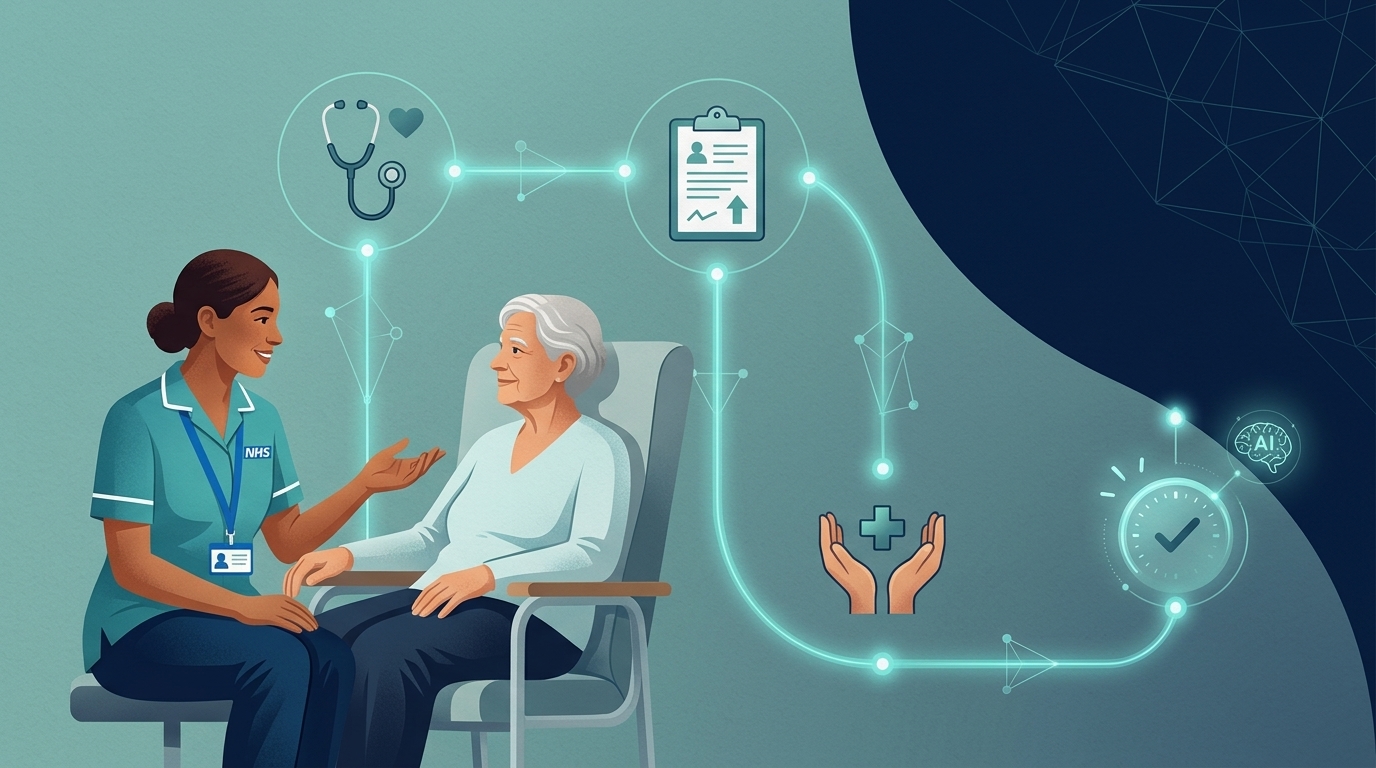
Dual evaluation — did the care achieve what was intended, and did the AI do what was needed, safely?
Accurate, complete, fair, worth it, defensible — test every AI output against these questions.
Report, don't work around — log AI problems through incident reporting so they can be learned from.
Evaluation asks whether care achieved what the person and team intended, and what should change. With AI, there is a second question: did the AI itself do what we needed, safely?
Dual evaluation: the care and the AI
- Outcome review: AI can summarise anonymised audit or outcome data you already hold. You interpret what it means.
- Structured reflection: AI can prompt structured reflection after a shift or an incident. The reflection must be yours. See Claims, concerns and issues.
- Was it accurate? Check it against the record, the person and authoritative sources.
- Was anything missing? Look for omissions as hard as for errors.
- Was it fair? Would the output have been different for a person of a different ethnicity, age, gender or disability?
- Did it save time for care, or just move the work? Checking AI output takes time too.
- Would I defend it? If it were questioned in a review, could you explain why you relied on it?
Report problems with AI tools through your organisation's incident reporting system, so they can be learned from. If a tool is a regulated medical device, problems can also be reported to the MHRA through its Yellow Card scheme.
Looking through the lenses
Person-centred practice
Does the person feel well cared for and involved? Ask them, not the AI.
Ways of knowing
Did AI shift how power, voice or fairness played out in this care? That's emancipatory knowing.
Novice to expert
A student evaluates each output against a checklist. An experienced nurse also spots patterns across many outputs and raises them.
Theoretical and regulatory underpinnings of evaluation (1983–2026)
In AI-enabled healthcare, evaluation is always dual: nurses evaluate whether care achieved the outcomes that mattered to the person, and simultaneously evaluate whether the AI system itself operated accurately, fairly, and safely within the clinical workflow.
Reflective Practice & Clinical Judgement
Donald Schön (1983), Graham Gibbs (1988), and Christine Tanner (2006) show that Reflection-on-Action is how nurses convert clinical experience into expertise. AI can prompt Socratic questions to structure a reflection, but writing your reflection for you destroys the learning loop required for NMC revalidation.
Fourth Generation Participatory Evaluation
Guba & Lincoln (1989) and Manley, Wilson & Øye (2021) established that evaluation in healthcare must include the people affected—patients, families, and frontline staff—surfacing Claims, Concerns, and Issues rather than relying solely on vendor accuracy metrics.
Sociotechnical Work Systems (SEIPS 2.0 / 3.0)
Holden et al. (2013) and Carayon et al. (2020) in the Systems Engineering Initiative for Patient Safety (SEIPS) model demonstrate that technology safety depends on how tools interact with people, tasks, environments, and organisation—including whether checking flawed AI drafts creates hidden cognitive burden.
Refusing the “Moral Crumple Zone”
Madeleine Clare Elish (2019) coined the moral crumple zone to describe how frontline human operators absorb blame when poorly designed automated systems fail—a risk highlighted by the WHO (2021) and International Council of Nurses (2023). Nurses protect patients and colleagues by formally logging recurring AI faults rather than silently working around them.
Post-Market Surveillance & Incident Reporting
Under NHS DCB0160, the Learn from Patient Safety Events (LFPSE) / Datix service, the MHRA Yellow Card scheme, and the 2026 National Commission Response, post-deployment monitoring by frontline clinicians is a primary pillar of UK AI regulation.
NMC Platform 4, Audit & Revalidation
NMC Future Nurse Platform 4 and NMC Code Standards 14, 19, and 20 require nurses to evaluate care outcomes with patients, act without delay when technology compromises safety, and participate in clinical audit and reflective practice.
Evolution of evaluation theory and AI post-market safety (1983–2026)
Go deeper: full milestone table with sources (5 rows)
| Year / Period | Key Scholars / Standard | Core Evaluation Principle | Application to AI in Evaluation Today |
|---|---|---|---|
| 1983–1988 | Schön (The Reflective Practitioner, 1983); Gibbs (1988) | Reflection-in-action and reflection-on-action build professional accountability and learning | Use AI only as a Socratic prompt; write your own clinical and revalidation reflections in your own voice |
| 1989–2021 | Guba & Lincoln (Fourth Generation Evaluation, 1989); Manley et al. (2021) | Participatory evaluation through stakeholder Claims, Concerns, and Issues | Evaluate new ward AI tools together with patients, carers, students, and staff—not just IT metrics |
| 2013–2020 | Holden et al. (2013); Carayon et al. (2020) (SEIPS 2.0 / 3.0) | Sociotechnical evaluation across person, task, tool, environment, and patient journey | Assess whether an AI tool genuinely frees time for bedside care or merely shifts work into editing and error-checking |
| 2019–2023 | Elish (Moral Crumple Zones, 2019); WHO (2021); ICN (2023) | Prevent frontline clinicians from absorbing blame for systemic algorithmic design flaws | Escalate recurring AI omissions or biases to the Clinical Safety Officer rather than normalizing silent workarounds |
| 2025–2026 | NHS DCB0160; LFPSE / Datix; MHRA Yellow Card; DHSC (2026) | Continuous post-market clinical safety surveillance and equity auditing | Report AI hallucinations, transcription errors, and biased outputs through Datix/LFPSE and MHRA Yellow Card |
Try it
Spot the error
Practise finding subtle clinical omissions and hallucinations in AI-drafted handovers and summaries.
AI risk calculator
Rate a planned use of AI before you start, then review how it performed afterwards.
Interactive scenario
Walk through a branching clinical AI decision scenario from assessment to evaluation.
Your ward trials an approved AI discharge-summary drafter. Over two weeks, you notice it repeatedly omits community district-nursing wound follow-up requests unless staff manually re-type them. How should you evaluate and act on this?
Related pages
Reading
- Schön, D.A. (1983) The Reflective Practitioner: How Professionals Think in Action. New York: Basic Books.
- Guba, E.G. and Lincoln, Y.S. (1989) Fourth Generation Evaluation. Newbury Park, CA: Sage.
- Holden, R.J., Carayon, P., Gurses, A.P., Hoonakker, P., Hundt, A.S., Ozok, A.A. and Rivera-Rodriguez, A.J. (2013) SEIPS 2.0: a human factors framework for studying and improving healthcare work systems and patient safety. Ergonomics, 56(11), pp. 1669–1686. doi:10.1080/00140139.2013.838643.
- Elish, M.C. (2019) Moral crumple zones: cautionary tales in human-robot interaction. Engaging Science, Technology, and Society, 5, pp. 40–60. doi:10.17351/ests2019.260.
- Carayon, P., Wooldridge, A., Hoonakker, P., Hundt, A.S. and Kelly, M.M. (2020) SEIPS 3.0: human-centered design of the patient journey for patient safety. Applied Ergonomics, 84, 103033. doi:10.1016/j.apergo.2019.103033.
- Department of Health and Social Care (2026) Government response to the National Commission into the Regulation of AI in Healthcare. London: DHSC.