Start here
- Nurses
- Students
- Educators
AI basics for nurses
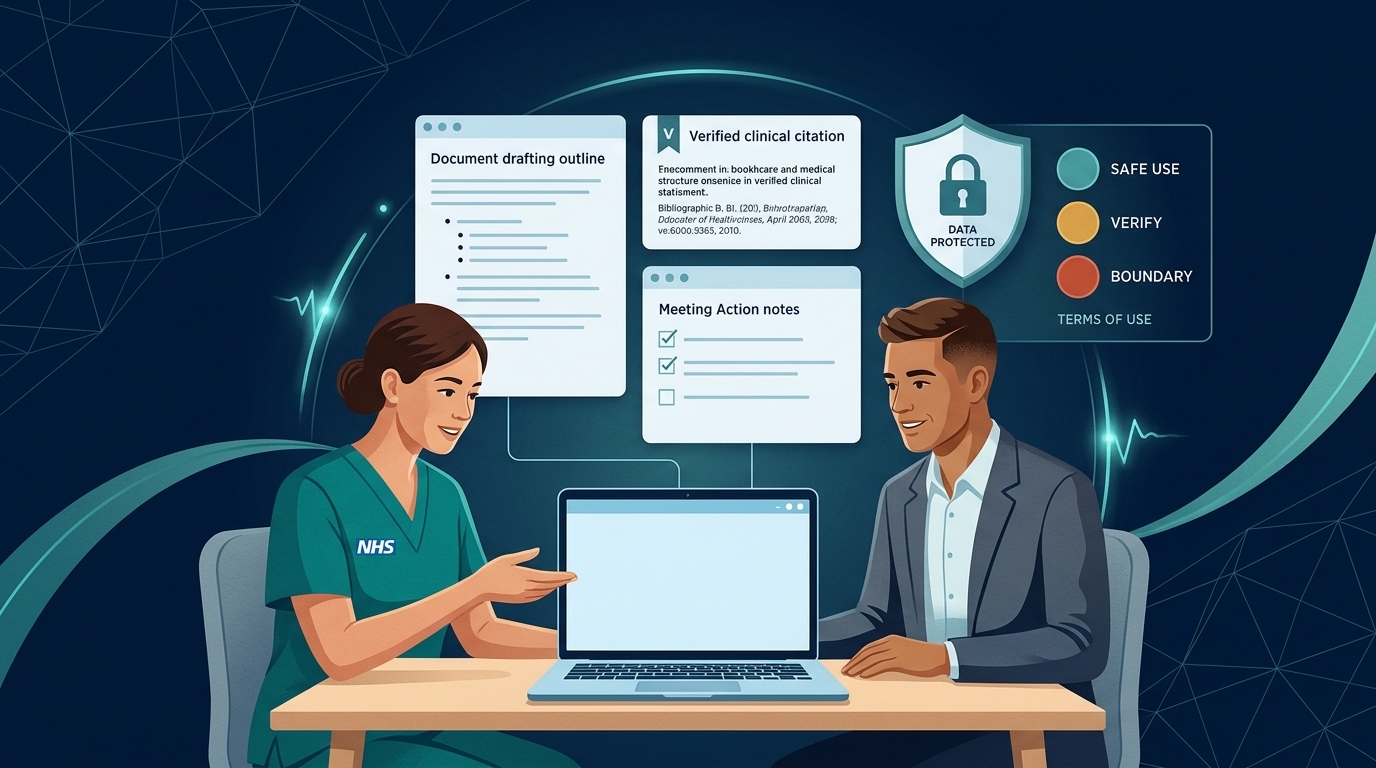
Language models predict the statistically most likely next word—they do not look up verified clinical facts unless grounded in a source you provide.
Rewording, summarising text you paste in, adjusting reading age, and generating study scenarios or first drafts to critique.
Fluent fabrication (hallucinated guidelines, doses, or citations) delivered with the exact same confident tone as accurate text.
What generative AI is
Generative AI tools, such as chatbots and image generators, are built on models trained on very large amounts of text, images or audio. A language model learns patterns in how words follow one another. When you type a prompt, it produces a response one piece at a time, choosing what is statistically likely to come next.
That's why it can write fluent paragraphs on almost anything, and also why it can be confidently wrong. It has no built-in sense of truth. It produces what sounds right.
What it tends to do well vs where it fails
Rewording, summarising and restructuring text you give it; producing a first draft to edit; explaining a concept at different reading levels; generating practice questions and role-plays; turning anonymised notes into a familiar structure such as SBAR.
Looking up drug doses or calculations; citing NICE/NMC guidelines from memory; making clinical triage decisions; interpreting unverified patient data; or assuming a fluent answer is clinically up to date.
Where it fails
The AI Playbook for the UK Government describes these limitations and how public services should manage them.
| Problem | What it looks like in nursing |
|---|---|
| Fabrication (often called hallucination) | Invented references, drug doses, guideline numbers or policies that don't exist |
| Out-of-date knowledge | Guidance that has since changed. Models learn from data up to a cut-off date. |
| Bias | Patterns from unequal data, such as stereotypes or poorer performance for some groups |
| False confidence | No signal that it is unsure. It sounds the same when it is wrong. |
| Missing context | It knows only what you tell it: not the person, the ward or the history |
How a well-structured nursing prompt reduces errors
Where your data goes
What you type into an AI tool is sent to the provider's computers. Depending on the tool and the account, it may be stored, reviewed by staff or used to train future models. Work and university accounts usually have stronger protections than personal accounts. Check before you use one. See Tool comparison for current models and privacy terms.
The models change constantly
New AI models are released every few weeks. This toolkit keeps model names in one regularly checked list, so pages stay current. Habits matter more than any one product: check, protect, and stay accountable.
A student nurse asks a general AI chatbot for the NICE guideline on managing acute sepsis, and the chatbot replies with a fluent, well-formatted paragraph citing 'NICE Guideline NG992 (2025)'. What is the safest clinical interpretation?