The nursing process
- Nurses
- Students
- Educators
- NMC platform 3
Assess
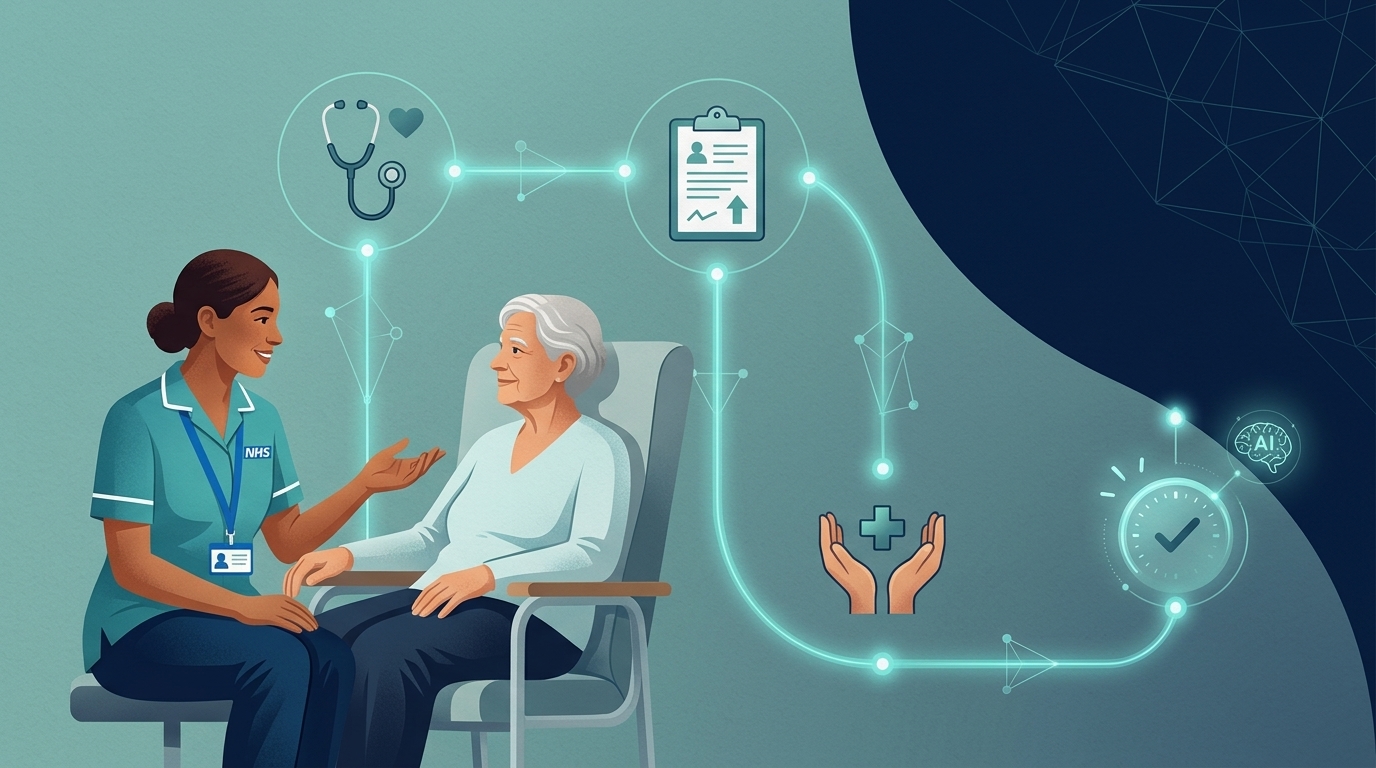
Building your picture of the person — their health, history, worries and what matters to them.
Approved scribes and note structuring — drafting notes, organising anonymised information and suggesting questions to explore.
Think first — form your own view before reading an AI summary, and check every draft before it is saved.
Assessment is where you build your picture of the person: their health, their history, what they're worried about and what matters to them. Everything that follows depends on it.
Where AI helps vs. where it can cause harm
- Recording the conversation: Ambient voice technology (AI scribes) can draft notes from a consultation, so you can look at the person instead of the keyboard. Your organisation must have approved the tool, and you must check the draft before it is saved. See AI scribes on placement.
- Structuring what you've gathered: An approved tool can organise your own anonymised notes into a familiar structure, such as a systems review or Activities of Living, so gaps are easier to spot.
- Prompting better questions: Before a first visit, AI can suggest questions to explore a condition you see rarely. You decide which ones are right for this person.
- Practising: Students can rehearse history-taking with a simulated patient. See History taking (chest pain).
- What wasn't said: AI only works with what it receives. Hesitation, body language, a smell, a home that doesn't match the story: you notice these, and AI doesn't.
- Mishearing and mis-attributing: Scribes can mix up speakers, mishear drug names or present a possibility as a diagnosis.
- Data at the source: Assessment is where the most sensitive information is collected, so it carries the highest data protection risk.
- Early anchoring: An AI summary can frame the problem before you have formed your own view.
Looking through the lenses
Person-centred practice
Did I find out what matters to the person, or only what is the matter with them?
Ways of knowing
What do I know from being in the room that isn't in the transcript or summary?
Novice to expert
A student checks every line of a draft against what they heard. An experienced nurse also asks what the draft is quietly leaving out.
Theoretical and regulatory underpinnings of assessment (1961–2026)
Nursing assessment is the foundation of the clinical cycle: any omission, misattribution, or bias introduced during assessment cascades into every subsequent decision. Seven decades of nursing theory and 2020–2026 clinical safety evidence explain why AI must never replace embodied human assessment.
Deliberative Validation vs Assumption
Ida Jean Orlando (1961) distinguished between automatic nursing reactions and deliberative nursing process: nurses must validate what they observe and hear directly with the patient before drawing conclusions. Accepting an unverified AI transcript or risk score reverts practice to automatic, unvalidated reaction.
12 Activities of Living & Context
Roper, Logan & Tierney (1980, 2000) framed UK nursing assessment around 12 Activities of Living shaped by biological, psychological, sociocultural, environmental, and politico-economic factors—reminding nurses to look for the home environment, carer strain, and unspoken cues that microphones and text prompts cannot capture.
Noticing & Early Anchoring Bias
Tanner (2006) identified Noticing as the critical first phase of clinical judgement, while Goddard et al. (2012) showed how early exposure to automated decision support creates anchoring and automation bias. Forming your own clinical impression before reading an AI summary protects diagnostic reasoning.
Sensor, Speech & Algorithmic Equity
The UK Equity in Medical Devices Independent Review (2024) and Obermeyer et al. (2019) demonstrated that pulse oximeters can overestimate oxygen saturation in darker skin tones and speech-to-text models have higher word-error rates for regional, non-native, or dysarthric speech—making physical A–E assessment essential.
Ambient Voice Technology (AVT) Governance
NHS England (2025–2026) and MHRA (2026) guidance on ambient scribing products mandate local Clinical Safety Officer sign-off (DCB0160), a Data Protection Impact Assessment (DPIA), transparent patient information with the right to object, and line-by-line clinician review before saving to the record.
NMC Platform 3 & Code Accountability
Under NMC Future Nurse Platform 3 (2018, updated 2024) and NMC Code Standards 5, 10, and 13, registered nurses remain personally accountable for holistic physical, mental, and social assessment and for ensuring clinical records accurately reflect the person.
Evolution of assessment theory and AI safety (1961–2026)
Go deeper: full milestone table with sources (5 rows)
| Year / Period | Key Scholars / Standard | Core Assessment Principle | Application to AI in Assessment Today |
|---|---|---|---|
| 1961 | Orlando (The Dynamic Nurse-Patient Relationship) | Validate verbal and non-verbal cues directly with the patient before concluding what is wrong | Never treat an AI summary or scribe draft as verified fact without checking back with the person |
| 1980–2000 | Roper, Logan & Tierney (Model of Nursing) | Holistic assessment across 12 Activities of Living and 5 contextual dimensions | Use AI only to help organise notes you have gathered; rely on human presence to assess environment, odour, affect, and family dynamics |
| 2006–2012 | Tanner (2006); Goddard, Roudsari & Wyatt (2012) | Noticing salient cues and guarding against pre-commitment / anchoring bias | Think First: conduct your A–E and holistic assessment before consulting an AI summary or risk score |
| 2024 | DHSC Equity in Medical Devices: Independent Review | Optical devices (pulse oximetry) and AI models can perform unequally across skin tones and demographics | Always pair device readings and automated scores with physical examination and clinical concern (NEWS2) |
| 2025–2026 | NHS England AVT Guidance; MHRA SaMD Clarification | DCB0129/0160 safety case, DPIA, patient consent/opt-out, and mandatory clinician verification | Obtain informed consent before using an approved AI scribe and correct speaker misattribution or drug-name errors before saving |
Try it
I'm a student nurse preparing to assess an older adult admitted after a fall.
Suggest open questions I could ask to understand what matters to them,
beyond the clinical facts of the fall. Explain why each question is useful.
Don't suggest any diagnosis.
A patient admitted with shortness of breath has an automated EPR deterioration score marked 'Low Risk', but during your A–E assessment you notice they are speaking in short phrases, look pale, and have increased work of breathing. What is the correct nursing action?
Related pages
Reading
- Orlando, I.J. (1961) The Dynamic Nurse-Patient Relationship: Function, Process and Principles. New York: G.P. Putnam's Sons.
- Roper, N., Logan, W.W. and Tierney, A.J. (2000) The Roper-Logan-Tierney Model of Nursing: Based on Activities of Living. Edinburgh: Churchill Livingstone.
- Tanner, C.A. (2006) Thinking like a nurse: a research-based model of clinical judgment in nursing. Journal of Nursing Education, 45(6), pp. 204–211.
- Department of Health and Social Care (2024) Equity in Medical Devices: Independent Review — Final Report. London: DHSC.
- NHS England (2026) Guidance on the use of AI-enabled ambient scribing products in health and care settings. London: NHS England.