Beyond text
- Nurses
- Students
- Educators
- NMC platform 3
- NMC platform 4
Voice
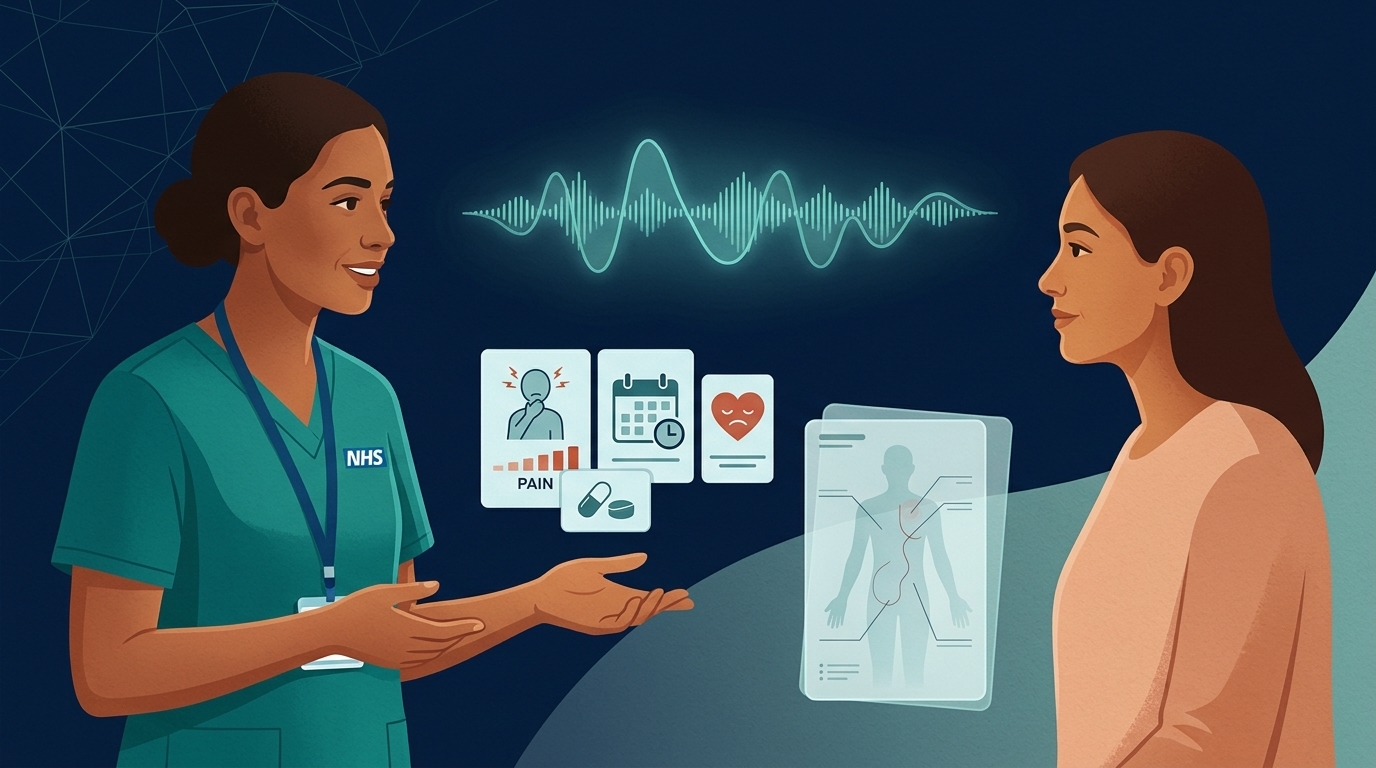
Require organisation approval (DCB0160/DPIA), informed patient consent, and line-by-line nurse checking.
Use voice mode with 100% invented personas to practise breaking bad news, SBAR, and de-escalation aloud.
Watch for higher transcription error rates across accents, dysarthria, stammering, and EAL speakers.
Ways voice AI appears in nursing
AI scribes (ambient voice)
Listen to a consultation and draft a note or letter. See AI scribes on placement for the NHS England requirements.
Dictation
Speech-to-text for your own notes, emails and documents on approved workplace devices.
Voice conversation with AI
Talking to a chatbot rather than typing — ideal for rehearsing difficult conversations or OSCE scenarios aloud.
Text to speech
AI voices reading information aloud, for people who prefer listening or have difficulty reading.
Where it helps
- More attention on the person: less typing during a conversation.
- Practice: rehearsing breaking bad news, de-escalation or history-taking out loud is closer to the real thing than typing.
- Accessibility: listening rather than reading suits many people, including some disabled and neurodivergent people.
Where it can cause harm
| Risk | What it looks like |
|---|---|
| Mishearing | Drug names, doses and medical terms transcribed wrongly; "no chest pain" becoming "chest pain" |
| Who said what | Words from a family member recorded as the patient's |
| Accent and speech bias | Poorer accuracy for some accents, people who stutter, people with dysarthria or people speaking English as an additional language. One study found commercial speech recognition made almost twice as many errors for Black speakers as for white speakers (Koenecke et al., 2020). See Equity and AI. |
| Consent and context | People not knowing they're being recorded, or not feeling able to say no |
| Synthetic voices | Cloned voices used to impersonate staff or relatives |
Good practice
- Use approved tools only, as approved by your organisation. A voice tool on a personal phone isn't approved for patient conversations.
- Explain and ask before using any recording or scribe, and respect a "no".
- Read every draft in full before it's saved, especially medicines, allergies, risks and anything the person said they didn't want recorded.
- Notice who the tool works less well for, and report it. This is emancipatory knowing in practice. See Ways of knowing.
- Be wary of urgent voice requests. If a "colleague" or "relative" calls with an unusual request, verify through a known route before acting.
Try it: rehearse a conversation
I'm a nurse practising how to respond when a relative is angry about a delayed discharge.
Play the relative. Speak naturally and stay in character for five exchanges.
Then step out of role and give me feedback on empathy, clarity and whether I made promises I can't keep.
Use voice mode in an approved tool. Invent all details.
In an approved AI ambient scribe draft, you notice that the patient's statement 'I have had no chest pain since Tuesday' has been transcribed as 'Chest pain since Tuesday', and a carer's comment has been attributed to the patient. What does this illustrate?