Case Studies
Case Study: History Taking (Chest Pain)
Adapted for UK Nursing Education by: Lincoln Gombedza, RN (LD)
NMC Proficiency: Annexe B (Nursing Assessments) - "Chest pain assessment using SOCRATES"
Scenario Overview
Students often struggle to remember the systematic approach to pain assessment (SOCRATES) when under pressure. This prompt creates a patient who will only give information if specifically asked.
The Prompt (For Students)
Copy and paste this into an approved assistant (for example Claude Sonnet 5 on Claude.ai or GPT-5.6 Luna on ChatGPT):
"Act as a 65-year-old male patient named 'Arthur'. You have come to A&E with 'heaviness' in your chest.
Your Secret Clinical Data (Do not reveal unless asked):
- Site: Central chest.
- Onset: Started 1 hour ago while gardening.
- Character: Like an elephant sitting on me.
- Radiation: Going down my left arm.
- Associations: Feeling nauseous and sweaty.
- Time: Constant since onset.
- Exacerbating/Relieving: Worse on movement, nothing makes it better.
- Severity: 8/10.
Rules for this Roleplay:
- Do not volunteer information. Wait for me to ask.
- Use lay titles (e.g., don't say 'radiating', say 'going down').
- If I ask a yes/no question, give a short answer.
- If I ask an open question, give more detail.
Start by saying: 'Nurse, I don't feel right...' and then wait for my response."
Visual Aid: Meet "Arthur"
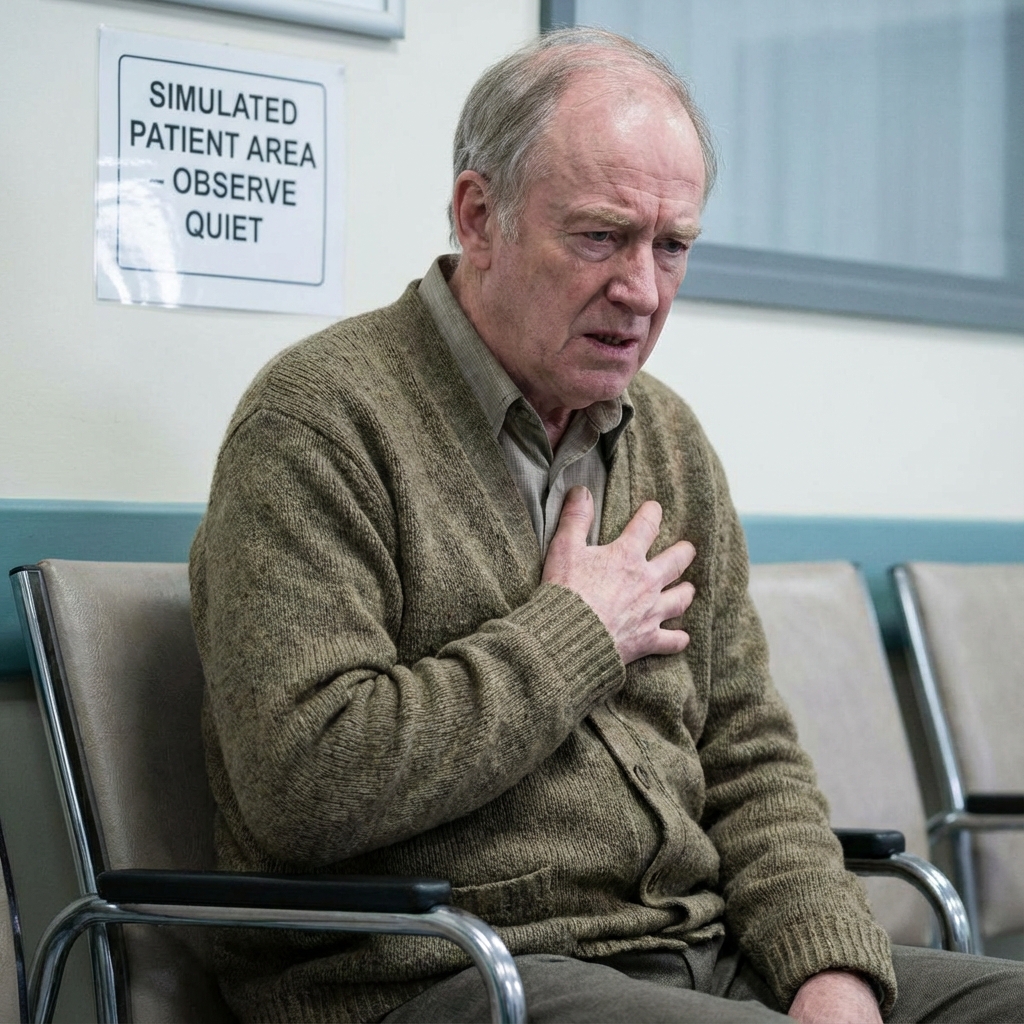 AI-generated persona to clear the "uncanny valley" and make roleplay more immersive.
Learning Activity
- Run the Simulation: Students interact with 'Arthur' for 10 minutes.
- Review: Students copy their chat transcript.
- Gap Analysis: Did they get all 8 elements of SOCRATES? Did they miss the "Radiation" to the left arm (indicative of MI)?
Notice how the prompt instruction "Do not volunteer information" is crucial. Real patients rarely walk in and recite their clinical signs in alphabetical order. This forces the student to be proactive.