The nursing process
Case Study: ECG Interpretation
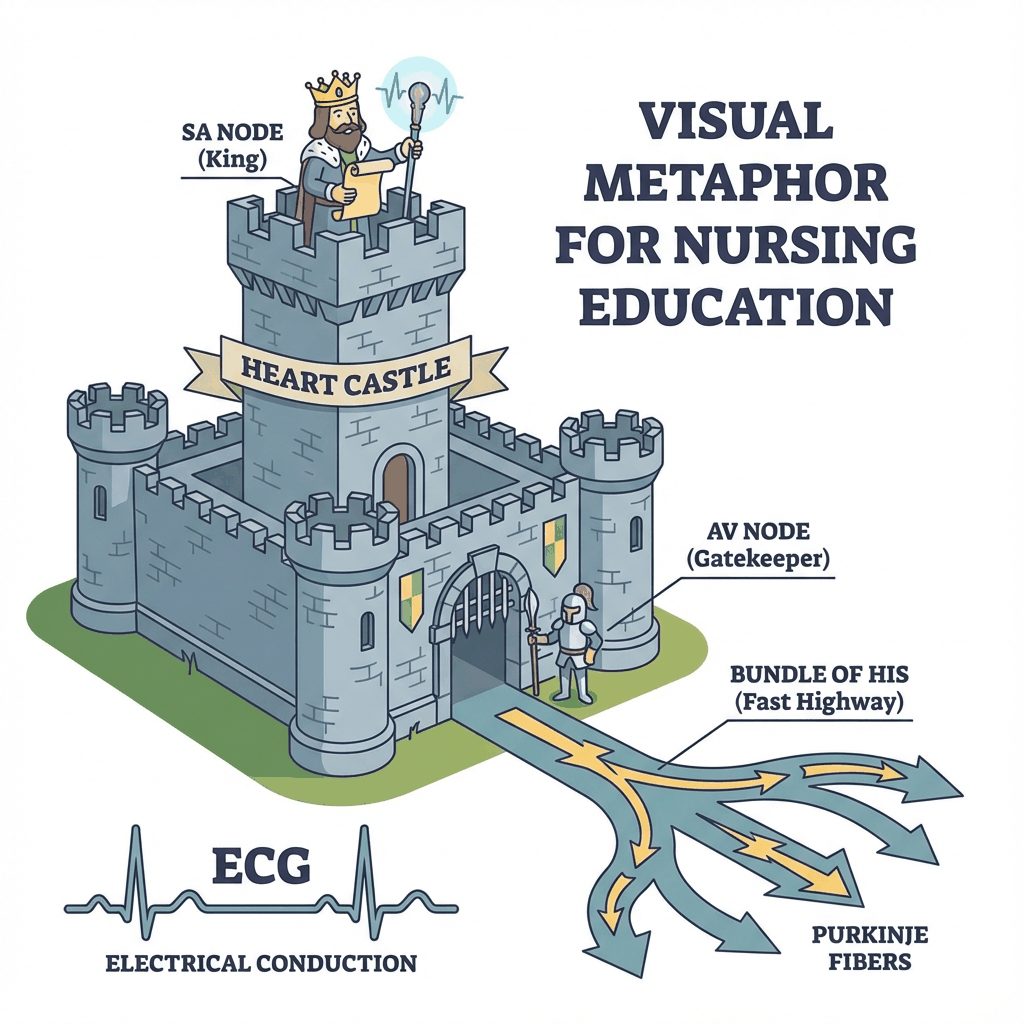
Year 1–2 students — linking cardiac conduction to the P-QRS-T waveform using a castle metaphor.
Theory revision — a visual metaphor and sequence diagram that build retrieval cues.
Never diagnose a real ECG — real traces must be reviewed by a qualified clinician, not a chatbot.
Scenario & Learning Brief
Linking Cardiac Conduction to the P-QRS-T Waveform
Students often struggle to connect the abstract electrical trace on an ECG paper to the mechanical sequence of cardiac chambers. This exercise uses a structured metaphor and sequence diagram to build retrieval cues.
Explain the P-QRS-T complex of a normal sinus rhythm to a first-year student.

The Visual Metaphor:
Use the analogy of a 'Message Runner' visiting different parts of a castle (The Heart).
* SA Node: The King giving the order.
* AV Node: The Gatekeeper pausing the message.
* Bundle of His: The Fast Highway.

The Diagram:
Create a Mermaid sequence diagram showing the electrical flow vs. time.
Cardiac conduction sequence diagram (P-QRS-T)
Theory Study vs. Live ECG Interpretation
“Photograph or type the patient's 12-lead ECG findings into a chatbot to check if ST elevation is present.”
Use AI only with synthetic learning prompts to study conduction physiology (P-QRS-T); always have real 12-lead ECGs reviewed immediately by a qualified clinician alongside the patient's clinical presentation.
Learning Outcome
Retrieval cues
By linking the abstract concept (electricity) to a concrete story (the castle), retrieval practice becomes easier.
Know the boundary
Students learn why asking an AI "I have an ECG here that looks like [description], what is it?" is dangerous.
The AI cannot see the 'whole clinical picture' and will often hallucinate a diagnosis based on text descriptions. Teach students why this is dangerous.
Quick self-check: ECG Learning vs Clinical Diagnosis
Why is a generative AI assistant helpful for explaining the physiological pause at the AV node using a metaphor, yet dangerous if asked to interpret a real patient's 12-lead ECG trace?