Microsoft Copilot
- Nurses
- Students
- Educators
Copilot prompt explorer
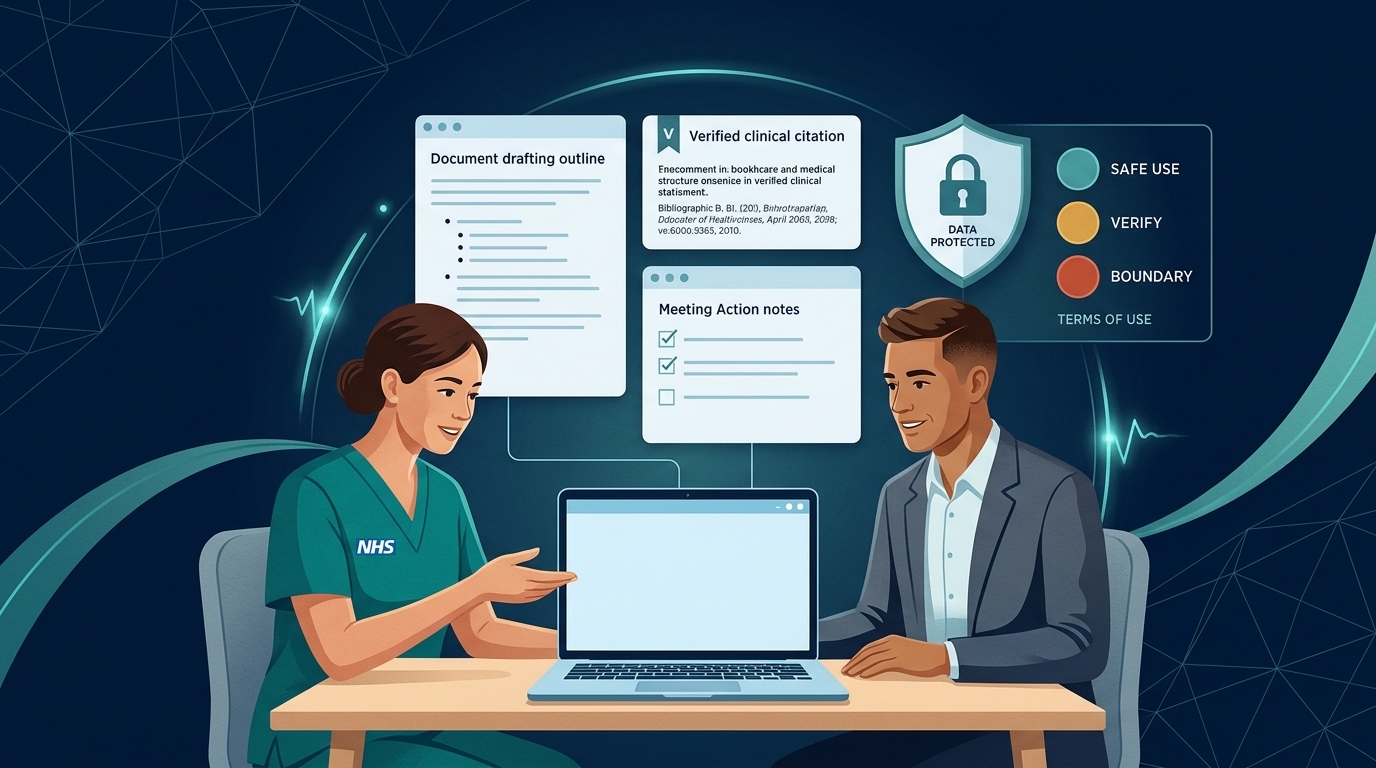
Sign in with your NHS or university work account so enterprise data protection is active.
Replace bracketed placeholders with generic, non-identifying details (never patient names or NHS numbers).
Every prompt carries a safe-use level and a what-to-check clinical verification box.
These prompts come from the NCD Nursing Copilot Handbook: one from each of its 49 chapters, covering everyday nursing work, every field of nursing, wider practice, and anti-racism and workforce standards. Each prompt follows the NCD Nursing Prompt Cycle and carries a safe-use level.
Before you use any prompt:
- use your work account in the Copilot your organisation has approved
- replace anything in brackets with non-identifying details
- check the output before you use or share it.
Every prompt here follows the NCD Nursing Prompt Cycle, which works across any modern AI assistant. You can use the learning, teaching, simulation and public-guidance prompts in ChatGPT, Claude, Gemini or Perplexity — as long as you only use synthetic or public information on a personal account, never NHS workplace, patient or staff data. See Comparing AI platforms.
Browse the prompts
Showing 49 of 49 prompts
A clearer handover template
Handover and organising your shift
When to use it: Your ward's handover sheet is cluttered or missing escalation prompts.
Using our attached blank handover sheet and the SBAR structure, redesign the template for an adult inpatient ward so that escalation actions, outstanding tasks and safety alerts are visible at a glance. Suggest headings, the prompt under each heading, and what to remove. Use no patient information. Show me the new layout before you write guidance notes.
Tip: Swap SBAR for I-SBAR or your local tool if your trust uses one.
Plain English rewrite
Communication and writing
When to use it: A document is full of jargon.
Rewrite the attached information for patients and families in plain English at about a reading age of 11. Keep every fact the same, replace medical terms with everyday words or explain them once, use short sentences, and list any statement you were unsure how to simplify so I can check it with the clinical lead.
Tip: Ask for a reading age of 9 for wider accessibility.
Agenda from a list of topics
Meetings, huddles and teamwork
When to use it: You chair a team meeting.
Turn these topics into a 45-minute team meeting agenda with timings, the decision or outcome needed for each item, and who leads it. Put items needing decisions first, and add five minutes for any other business.
Tip: Send the agenda two days before.
What's changed between two versions
Policies, guidance and putting evidence into practice
When to use it: A policy has been updated.
Compare the attached old and new versions of this policy. Produce a table of every change: section, old wording, new wording, and what it means for nursing practice. Quote exactly and do not interpret anything ambiguous; list those items as questions for the policy owner.
Tip: Share the change table at the next huddle.
Project charter
Quality improvement and audit
When to use it: You're starting an improvement project.
Draft a one-page quality improvement charter for [project]: problem statement, aim using the SMART format, scope, measures (outcome, process, balancing), team roles, and timeline. Keep it as a draft with placeholders where I need to add local data.
Tip: Share it with your QI team for coaching.
Learning summary from a de-identified account
Patient safety and learning
When to use it: An incident needs a team learning summary.
Using this de-identified account of what happened, draft a one-page learning summary for the team: brief description, contributing factors (systems, environment, communication, workload), what we are changing, and two reflection questions. Use just-culture language and name no individuals.
Tip: Check with your patient safety team before sharing.
Teaching session plan
Teaching and practice learning
When to use it: You're teaching a short session.
Plan a 30-minute teaching session for [audience] on [topic]: three learning outcomes, an opening activity, the main content, an interactive task, a quick check of learning, and a summary. Base the content on the attached source and list resources I'll need.
Tip: Ask for an online version too.
Team vision on a page
Leadership and managing a team
When to use it: Your team needs shared direction.
From my notes from our team away-day, write a one-page team vision: our purpose, three priorities for the year, how we'll work together, and how we'll know we're succeeding. Use the team's own words where I've quoted them.
Tip: Put it up where everyone can see it.
Formula explained
Working with data in Excel
When to use it: You've inherited a spreadsheet.
Explain in plain English what each formula in this workbook does, which cells feed into which, and anything that looks fragile, such as hard-coded numbers or broken references. Add a hidden notes column explaining each formula for the next person.
Tip: Check the workbook holds no personal data first.
Reflective account structure
Professional development, revalidation and careers
When to use it: You need a reflective account for revalidation.
Organise my rough notes below into the NMC revalidation reflective account headings: what was the nature of the CPD, practice-related feedback or event; what did you learn; how did you change or improve your practice; how is this relevant to the Code. Keep my words and first-person voice, invent nothing, and add bracketed questions where my notes are thin.
Tip: Remove anything that could identify patients or colleagues.
Fundamentals of care audit questions
Adult nursing
When to use it: You want to look at essential care on your ward.
Draft a set of observation and conversation prompts for a fundamentals of care review on an adult ward covering nutrition and hydration, comfort, dignity, continence, mobility and communication. Make the questions respectful of patients and staff, and design them to be recorded as anonymous, aggregated findings only.
Tip: Include the patient's own view of their care.
Corridor care standards briefing
Emergency and urgent care
When to use it: Your department is caring for people in non-standard spaces.
Using our attached trust policy on care in temporary escalation spaces, write a one-page briefing for emergency department nurses on maintaining dignity, safety, privacy, observations and escalation when care happens outside a cubicle. Quote the policy for any required actions.
Tip: Include how to escalate concerns about the environment.
Family information about intensive care
Critical care and perioperative nursing
When to use it: Families arrive overwhelmed.
Using our approved critical care information attached, write a gentle one-page guide for families visiting intensive care for the first time: what they will see and hear, equipment in general terms, how they can help, visiting arrangements and support available. Add nothing beyond the source.
Tip: Have families review the wording.
Mental Health Act 2025 changes explained
Mental health nursing
When to use it: Your team needs a clear overview.
Using the published summaries I've attached and our trust's implementation updates, write a two-page staff briefing on the Mental Health Act 2025: the aims of the reforms, which changes are in force now, which are still to come, and what nurses should do differently today. Mark clearly what is not yet in force.
Tip: Check with your MHA administration team.
Reasonable adjustments checklist
Learning disability nursing
When to use it: A service needs to make reasonable adjustments.
Create a reasonable adjustments checklist for a hospital or community service supporting people with a learning disability and autistic people: communication, environment, time, information formats, involving families and supporters, and flagging needs in the clinical record. Base it on the Equality Act 2010 and published NHS guidance, citing both.
Tip: Test it with self-advocates.
Age-appropriate explanation
Children and young people's nursing
When to use it: You need to explain a procedure to a child.
Using our attached approved information, write explanations of [procedure] for three age groups (under 5s for parents to read aloud, 6 to 11, and teenagers), with honest, gentle wording and suggestions for play or distraction. Add no clinical detail beyond the source.
Tip: Your play specialist can review it.
Martha's Rule in maternity and neonatal units
Maternity, neonatal and family care
When to use it: Your unit has adopted Martha's Rule.
Using our attached unit plan and NHS England material, write a leaflet for women, birthing people and families explaining how to request an urgent review if they're worried their or their baby's condition is getting worse and they feel unheard. Plain English, reassuring, with our local number.
Tip: Make it available in your community's languages.
Lone working safety plan
Community and district nursing
When to use it: Your team visits people at home alone.
Using our attached lone working policy, write a one-page lone working safety guide for community nurses: planning visits, checking in and out, what to do if a visit feels unsafe, using the lone worker device, and escalation. Quote the policy for required steps.
Tip: Review it after any near miss.
Long-term condition review template structure
General practice nursing
When to use it: Your review templates are inconsistent.
Suggest the structure of a person-centred annual review for [long-term condition], drawing on the attached national guidance: what matters to the person, care planning, education and self-management, and agreed goals. This is for discussion with the practice's clinical lead before building in the clinical system.
Tip: Build the actual template in your clinical system.
Healthy Child Programme update briefing
Public health nursing: health visiting, school nursing and occupational health
When to use it: Your team needs to understand the 2026 guidance.
Using the 2026 Healthy Child Programme delivery guidance and high-impact area framework I've attached, create a team briefing: what's new, the high-impact areas for 0 to 5 and 5 to 19, service levels, supervision expectations, and questions for our commissioners. Quote the guidance and add nothing.
Tip: Map your current offer against it.
What matters to me conversation
Older people, frailty and dementia care
When to use it: You want care to start from the person.
Create a conversation guide for nurses to learn what matters to an older person: open questions about routines, preferences, relationships, worries and goals, and how to record the answers in the care plan. Respectful and unhurried.
Tip: Involve families with the person's agreement.
Last days of life information for families
Palliative and end of life care
When to use it: Families want to understand what's happening.
Using our attached approved information, write a compassionate leaflet for families about changes that may happen in the last days of life, how they can be with their person, and how the team will support them. Add nothing beyond the source.
Tip: Hand it over with a conversation, not instead of one.
Self-management education session
Long-term conditions and specialist nursing
When to use it: You run group education.
Plan a group self-management education session for people living with [condition] based on the attached approved programme materials: aims, activities, key messages, and how participants set their own goals. Inclusive and non-judgemental.
Tip: Include peer stories with consent.
Care home student placement offer
Adult social care and care home nursing
When to use it: You want to host nursing students.
Using the social care nursing student placement strategy materials I've attached, create a placement offer for our care home: learning opportunities, supervision arrangements, what students will gain about person-centred care, and how universities can contact us.
Tip: Highlight the leadership opportunities in social care.
Health information for people in prison
Forensic, secure and justice settings
When to use it: People need accessible health information.
Using approved NHS material I've attached, write accessible health information for people in prison about [topic, e.g. how to request a healthcare appointment], at about reading age 9, respectful and non-judgemental, with no information that could compromise security.
Tip: Check it with your security department.
Scope of practice explainer
Nursing associates
When to use it: Colleagues are unsure what nursing associates do.
Using the NMC standards of proficiency for nursing associates and our attached local scope of practice policy, write a one-page explainer for ward teams on the nursing associate role, how it complements registered nurses, and how to delegate appropriately. Quote the standards.
Tip: Share it with every new team you join.
Revision plan
Students and newly registered nurses
When to use it: Exams are coming.
Create a six-week revision plan for my [module] exam from the learning outcomes I've pasted: topics by week, active recall activities, practice questions and rest days. Keep it realistic around placement shifts.
Tip: Check your university's guidance on using AI.
Pastoral welcome plan
Internationally educated nurses and returning to practice
When to use it: Internationally educated nurses are joining your team.
Create a pastoral welcome plan for internationally educated nurses joining our organisation: before arrival, first week, first three months, buddying, community connections, wellbeing check-ins, and how we'll listen to their experience. Respectful of the expertise they bring.
Tip: Ask previous recruits what helped.
Four pillars portfolio map
Advanced and consultant practice
When to use it: You're building your advanced practice portfolio.
Create a portfolio mapping tool for the four pillars of advanced practice (clinical practice, leadership and management, education, research) with capabilities from the multi-professional framework I've attached as rows and columns for evidence, date and supervisor sign-off.
Tip: Use the official framework wording.
Turning a question into a research question
Research and academic nursing
When to use it: You have an idea from practice.
Help me turn this practice question into a focused research question using the PICO or PEO format, suggest suitable study designs, and list what I'd need to search for to check what's already known.
Tip: Talk to your research and development team next.
Team wellbeing check-in
Staff wellbeing and retention
When to use it: You want a regular wellbeing pulse.
Design an anonymous five-question team wellbeing pulse survey for a nursing team, with a free-text 'one thing that would help' question, a privacy statement and signposting to support at the end.
Tip: Act on what you hear and say what changed.
Copilot safe-use briefing for a team
Digital nursing and safe AI
When to use it: Your team is getting Copilot.
Create a ten-minute briefing for a nursing team getting Microsoft 365 Copilot: what it can and can't do, the red lines (no patient-identifiable data, no clinical decisions), what to check in every output, and who to ask. Base it on our attached organisational guidance and NHS England's Copilot information governance guidance.
Tip: Use your organisation's approved policy as the anchor.
Green ward action plan
Sustainability and greener nursing
When to use it: Your ward wants to reduce waste.
Create a green ward action plan: waste segregation, reducing unnecessary glove use per our attached infection prevention guidance, energy, paper, and medicines waste, with simple aggregated measures and a team champion role.
Tip: Start with one change and measure it.
Outcome brief for an agent
Agents, Notebooks and Researcher
When to use it: You want an agent to prepare a report.
I want a monthly ward quality pack ready for the first Monday of each month. Work only from the aggregated dashboards in [folder], following the layout of last month's pack. Produce a one-page summary, three charts and a short huddle briefing. Use de-identified data only and leave the source files untouched. Show me the summary first and wait for my go-ahead before making the charts.
Tip: Brief the outcome, not the clicks.
Accessible Information Standard explainer
Accessible information, interpreting and language
When to use it: Staff don't know what the standard requires.
Using the published Accessible Information Standard specification and our attached local procedure, create a short staff briefing on the five steps (identify, record, flag, share, meet), with examples of needs such as large print, British Sign Language, easy read, braille and communication support, and how our systems record them.
Tip: Check how needs are flagged in your clinical system.
Care Act principles refresher
Safeguarding adults and public protection
When to use it: Staff need a safeguarding adults refresher.
Using the Care Act 2014 statutory guidance and our attached safeguarding adults policy, create a refresher for nurses on the six safeguarding principles, types of abuse, Making Safeguarding Personal, and how to raise a concern locally. Fictional examples only.
Tip: Threshold decisions go to your safeguarding team.
Inclusion health framework briefing
Inclusion health
When to use it: Your team is new to inclusion health.
Using NHS England's published framework for action on inclusion health, create a briefing for a nursing team: who inclusion health groups are, why outcomes are worse, the framework's principles, and what our service could do differently.
Tip: Invite a peer advocate to co-present.
Reasonable adjustments passport template
Disability and neurodiversity inclusion at work
When to use it: Adjustments get lost when people move.
Create a reasonable adjustments passport template for staff, owned by the staff member: what helps me work well, agreed adjustments, review dates and who has agreed them. Include guidance for managers on using it. Template only.
Tip: The staff member decides what goes in it.
Trauma-informed principles in nursing
Trauma-informed practice and duty of candour
When to use it: Your team wants a shared approach.
Using the published working definition of trauma-informed practice from the Office for Health Improvement and Disparities, create a session for nurses on the six principles (safety, trust, choice, collaboration, empowerment and cultural consideration) with examples from everyday nursing.
Tip: Start with what staff already do well.
Medicines policy quick guide
Medicines safety and governance (awareness)
When to use it: Staff can't find the key points.
Summarise our attached medicines policy into a quick guide for nurses on the processes only (storage, controlled drug checks, administration records, incident reporting and who to contact), quoting the policy for every requirement and adding no clinical guidance.
Tip: Pharmacy should approve the guide.
Which guidance applies?
Working across the four UK nations
When to use it: You've moved or work across a border.
Explain which bodies publish nursing guidance and standards in England, Wales, Scotland and Northern Ireland, how health service structures differ, and which UK-wide requirements stay the same, such as the NMC Code. Point me to official sources to verify.
Tip: Check the nation's own health department site.
Inclusive language review
Equality, inclusion and belonging
When to use it: You want your documents to be inclusive.
Review the attached document for language that could exclude or stigmatise people because of race, disability, sex, gender identity, sexual orientation, age, religion or belief, or social background. Suggest inclusive alternatives line by line and explain why each matters.
Tip: Inclusive language evolves. Ask the communities concerned.
Gap analysis against the exact wording
Tackling racism: NHS Staff Standard 5 and the Lord Mann Review
When to use it: You are benchmarking your organisation against Standard 5.
Using the attached published text of NHS Staff Standard 5 (Tackling racism), list every action the standard says employers 'must' take, quoting each one word for word. For each, add three columns for me to complete: evidence we hold, met / partially met / not met, and the gap. Do not judge compliance yourself and do not shorten any requirement.
Tip: Have a second person check your ratings against the wording.
Principle 1: Name racism
The seven anti-racism principles in practice
When to use it: Leaders find it hard to say the word.
Using the Race and Health Observatory's published Principle 1 (Name racism), draft a short message a nursing director could share with staff that acknowledges racism exists, asks how it operates in our services, and commits to action, referring to our published WRES findings. Then list three ways leaders can keep naming racism in routine meetings.
Tip: Naming racism signals that it's safe to talk about it.
Indicators in plain English
WRES, WDES and equality reporting
When to use it: Colleagues find the indicators confusing.
Using the official WRES and WDES technical guidance I've attached, explain each indicator and metric in one plain English sentence, what a relative likelihood is, and what 'above 1' means. Quote the guidance for each definition and add nothing.
Tip: Share it with board members before the report.
One-page overview for a team
The six NHS Staff Standards
When to use it: Your team hasn't heard of the standards.
Using the attached NHS Staff Standards document, create six slides, one per standard, each stating in plain English what staff can expect, quoting the standard's own headline wording, and one question for staff to discuss. Add a final slide on how to raise concerns.
Tip: Ask staff which standard feels furthest from reality.
Sexual safety awareness session
Sexual safety at work
When to use it: Your team needs awareness training.
Using the attached NHS Staff Standard 4 (sexual safety) wording and our policy, create a 30-minute awareness session: what sexual harassment and misconduct are, the duty to prevent sexual harassment, bystander actions, how to report, and support available. Trauma-informed tone with a content note at the start.
Tip: Offer a way to leave the session without explanation.
Violence prevention plan
Preventing violence and aggression
When to use it: Your area has rising incidents.
Using the attached Standard 3 wording, the Violence Prevention and Reduction Standard and our aggregated incident trends, draft an area violence prevention plan: environmental changes, de-escalation training, staffing, communication with patients and visitors, post-incident support and how we'll monitor progress.
Tip: Ask staff where and when they feel least safe.
PCREF explained for nursing teams
Race equity in patient care
When to use it: Your mental health trust is implementing PCREF.
Using NHS England's published Patient and Carer Race Equality Framework and our trust's plan, create a briefing for mental health nursing teams: why PCREF exists, its components, what changes for practice, and how patients and carers will shape it. Quote the framework.
Tip: Involve your PCREF community partners in delivering it.
The full handbook
The full NCD Nursing Copilot Handbook has 365 prompts in 49 chapters plus 46 quick prompts. For copies, training, licensing, or to suggest new prompts, use our Feedback and Ideas form.
Microsoft and Copilot are trademarks of Microsoft. Nursing Citizen Development is independent and not affiliated with Microsoft.