Teaching and learning
- Educators
- Students
- Practice supervisors
- Programme leads
- NMC platform 1
- NMC platform 3
- NMC platform 4
- NMC platform 5
- NMC platform 6
Nursing curricula, assessment and practice supervision
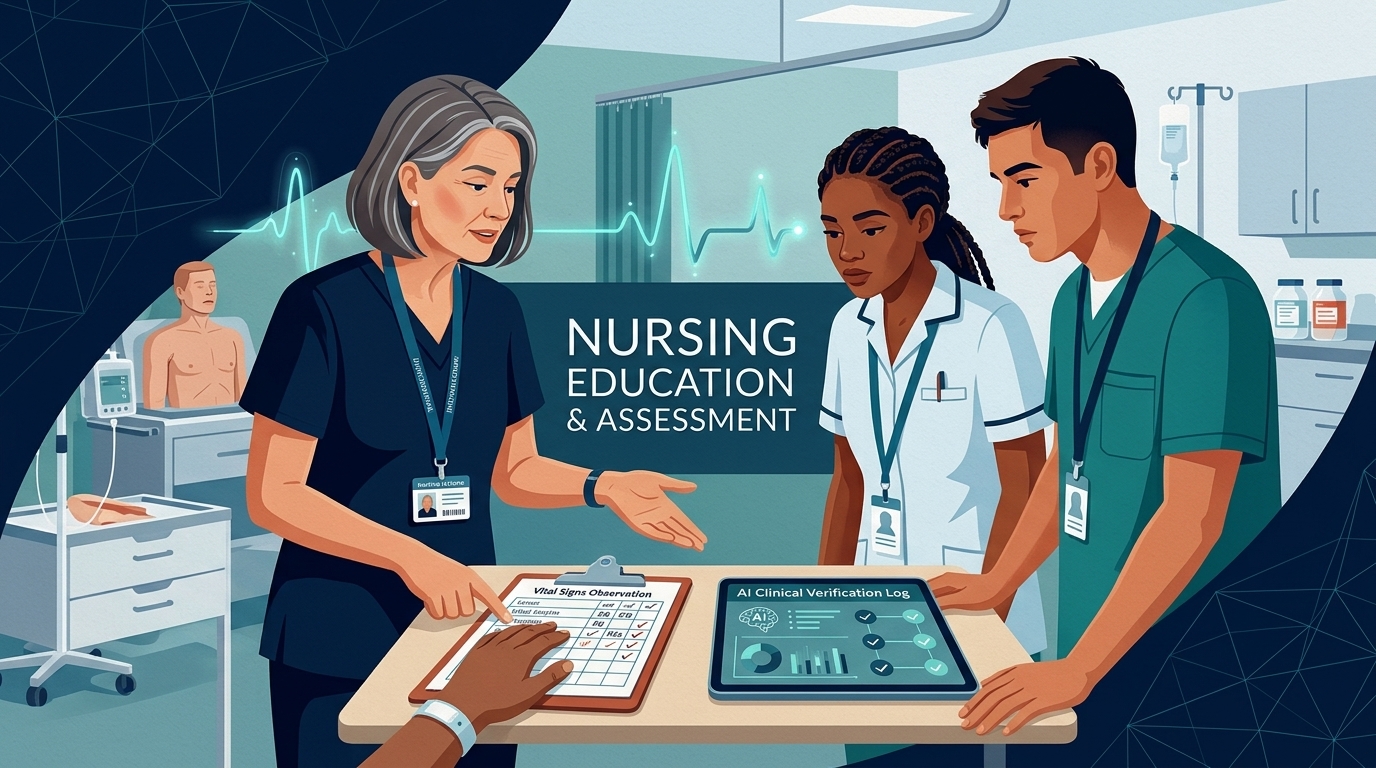
Across the UK and internationally, nursing education has moved from treating generative AI solely as an academic-misconduct risk to teaching critical AI literacy as a core clinical competency. This page gives programme leads, lecturers, practice supervisors and students a practical blueprint for curriculum design, assessment and placement supervision.
Aligned with NMC R1.1.7, Council of Deans of Health (2026) Principles, and EU AI Act Article 4.
Balance Lane 1 (invigilated OSCEs, PAD & numeracy) with Lane 2 (AI-verified coursework + verification log).
Under NMC SSSA, Practice Supervisors enforce local trust IG rules and model line-by-line checking of ambient scribes.
1. How this toolkit aligns with UK & international curriculum frameworks
| Framework | What it requires for nursing education | How this toolkit maps to it |
|---|---|---|
| NMC Standards for Pre-Registration Nursing Programmes (R1.1.7) & Future Nurse Proficiencies | Approved Education Institutions (AEIs) must ensure students have foundational digital and technological literacy on entry and develop it throughout their programme across all 7 Platforms. | Mapped proficiency-by-proficiency in the NMC Proficiency Mapping Tool and structured around Assess, Plan, Implement, Evaluate (APIE). |
| Council of Deans of Health (Feb 2026): Principles for the use of Generative AI in Healthcare Education | Calls for human oversight, service-user and carer voice in AI education, equitable student access (no requirement for paid consumer subscriptions), authentic assessment, and teaching verification of AI outputs. | Built on free/institutional access (Microsoft Copilot and 100 free courses), Equity and AI, and Spot the error verification exercises. |
| NHS England AI and Digital Healthcare Technologies Capability Framework | Prepares healthcare staff not just to use digital and AI tools safely, but to co-design, lead and govern them across career stages. | Matched to Benner's Novice to Expert progression and the three Nurse Citizen Developer stages (Foundation → Builder → Advanced). |
| National Commission into the Regulation of AI in Healthcare (MHRA / GOV.UK, Sept 2026) | Recommends coordinated AI education across initial healthcare education and continuing professional development (CPD) so clinicians understand software boundaries and post-market reporting. | Covered in Governance, safety and the EU AI Act and Evaluate. |
| EU AI Act Article 4 (AI Literacy) & AACN Essentials Domain 8 | Requires role-stratified AI literacy for staff and learners interacting with AI systems (EU Article 4) and competency in informatics and healthcare technologies (AACN Domain 8). | Provides role-specific pathways for students, registrants, practice supervisors and educators. |
2. The "Two-Lane" assessment model for nursing programmes
Uninvigilated take-home essays alone cannot assure the NMC that a student can think safely at the bedside. Higher-education quality bodies (including QAA guidance in the UK and international two-lane assessment frameworks) recommend balancing assured, AI-free assessments with transparent, AI-integrated coursework:
Purpose: Prove that the individual student holds the foundational knowledge, numeracy and bedside judgement needed for patient safety without digital assistance.
- OSCEs and simulated clinical stations: Unassisted physical assessment, A–E deterioration response, SBAR handover and therapeutic communication.
- Practice placement assessment (PAD / MORA): Direct observation by Practice Supervisors and Practice Assessors in real care settings.
- Invigilated medicines and numeracy exams: Drug calculations and pharmacology safety checks.
- Short oral/viva defences: Asking the student to explain the clinical reasoning behind their written care plan in person.
Purpose: Teach and assess how students use, critique and verify AI tools transparently in realistic professional workflows.
- Critique an AI-generated care plan: Students generate a draft care plan for a synthetic persona and are graded on how thoroughly they identify its clinical omissions, US-centric assumptions and bias using Ways of knowing.
- Accessible patient information project: Use AI to adapt a clinical leaflet for different reading ages or learning disability needs, then evaluate it against person-centred checks.
- Quality improvement / Citizen Developer pitch: Scope a safe, non-clinical digital improvement using the Build with AI route, including a hazard and equity check.
Around 38% of UK students report that their university provides institutional AI tools (HEPI Student Generative AI Survey, 2026). Never design an assessment where higher marks depend on a £20/month personal subscription. Anchor tasks in your university's Microsoft 365 Copilot account or free, open-access tools.
3. Copy-paste Student AI Use & Verification Log
In any Lane 2 assignment where AI is permitted, require students to include a short verification log at the end of their submission. This shifts grading from policing undeclared use to rewarding rigorous clinical checking:
Student AI Use and Clinical Verification Declaration
Student AI Use and Clinical Verification Declaration
----------------------------------------------------
1. Tool and account used:
   [e.g. Microsoft 365 Copilot on university work account / No AI used]

2. How I used it (stage of work):
   [e.g. Brainstorming structure / testing my draft care plan / plain-English check]

3. Key prompt(s) used:
   [Paste the main prompt(s) following the NCD Prompt Pattern]

4. How I verified the output against authoritative UK sources:
   [e.g. Checked medication details against BNF (date), guideline steps against
   NICE NG..., and nursing care against Royal Marsden Manual]

5. What errors, omissions or biases I found and corrected:
   [e.g. The AI suggested a US protocol and omitted sensory/communication needs;
   I replaced this with...]
4. Guidance for Practice Supervisors and Practice Assessors (NMC SSSA)
Under the NMC Standards for Student Supervision and Assessment (SSSA), Practice Supervisors and Practice Assessors bridge university learning and clinical reality. As NHS trusts roll out Microsoft 365 Copilot, ambient voice scribes and EPR decision support, three practical rules apply on placement:
Placement Governance Comes First
Make clear on day one which tools are approved in your trust or care home, and that no patient, family or staff details (even without names) may ever be typed into a personal phone or personal AI account.
Model Line-by-Line Checking
If your area uses an approved AI ambient scribe, show the student how you gain patient consent and edit every line against your assessment. Do not let novices rely on AI summaries before they can write notes themselves.
Authentic Placement Reflections
Encourage students to write placement reflections in their own voice, and ask one or two spoken questions during midpoint and final interviews to hear their genuine clinical reasoning.