Accountable use
- Nurses
- Students
- Educators
- Programme leads
- Practice development leads
- NMC platform 1
- NMC platform 2
- NMC platform 7
Ethics, sustainability and professional judgement
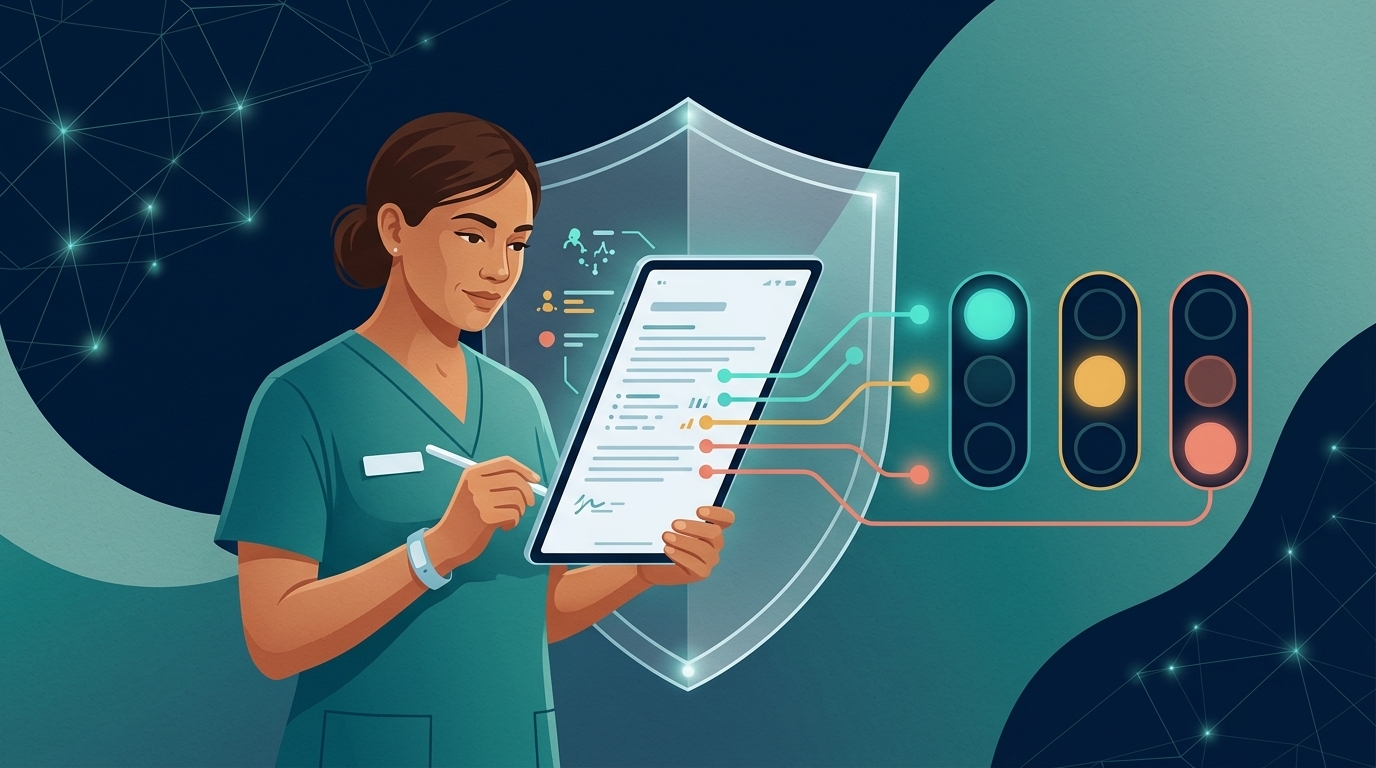
Ethical AI use in nursing is about more than keeping personal data secure. It asks how technology changes human judgement, the therapeutic relationship, fairness, and planetary health.
AI cannot hold moral responsibility. Guard against both automation bias (over-trusting output) and the moral crumple zone.
Think first, prompt second, verify third: form your own clinical impression before asking AI to critique or expand it.
Align digital habits with Greener NHS Net Zero (2040/2045): use direct search for BNF/NICE lookups and avoid wasteful re-prompting.
1. Global nursing and health AI ethics frameworks
Four major position statements anchor ethical AI use in nursing:
| Body | Core ethical message for nurses | Key source |
|---|---|---|
| World Health Organization (WHO) | Six core principles for AI in health and 40+ recommendations on Large Multi-Modal Models (LMMs): protect human autonomy, promote safety, ensure transparency, foster accountability, advance equity, and build sustainable systems. | WHO Guidance on Ethics and Governance of LMMs (2024) |
| International Council of Nurses (ICN) | Digital health and AI must strengthen — never replace — the nurse–patient relationship, protect data privacy, and involve nurses as co-designers and leaders rather than passive end-users. | ICN Position Statement on Digital Health Transformation (2023) |
| American Nurses Association (ANA) & American Academy of Nursing (AAN) | Nurses remain personally accountable for clinical decisions; AI cannot hold moral responsibility. Nurses must guard against biased algorithms and preserve human-centred care. | ANA Ethical Use of AI in Nursing Practice (2025) · AAN Position Statement (2026) |
| Nursing and Midwifery Council (NMC) | The Code applies in full whenever you use digital or AI tools; the NMC is developing shared regulatory AI principles with the Professional Standards Authority (PSA) and updating the Code. | The NMC Code review and AI |
2. Moral agency, automation bias and the "moral crumple zone"
When an AI tool gives a confident-sounding summary or risk score, two opposite human errors can happen:
- Automation bias: Over-trusting the machine and failing to check the primary record or the patient in front of you — especially on a busy shift when cognitive load is high.
- Algorithmic aversion / alert fatigue: Ignoring a valid warning because the system produces too many false alarms.
In safety engineering, a moral crumple zone happens when a poorly designed automated system leaves the frontline professional to absorb the blame when an error occurs, without giving them the time, training or visibility to verify the output properly.
As a nurse, educator or manager:
- Never treat "human-in-the-loop" as a rubber-stamp step without protected time to check the source.
- If an AI workflow makes safe checking unrealistic in real staffing conditions, escalate that as a system risk (NMC Code Standard 16) rather than carrying it silently.
3. Relational ethics: "synthetic empathy" vs nursing presence
Studies frequently show that chatbots can draft patient replies that raters score as polite and "empathetic" — largely because an LLM never runs out of time or gets fatigued.
Through the toolkit's Person-centred practice and Ways of knowing lenses, it is vital to distinguish worded politeness from nursing care:
Fluent, unhurried text patterns that mimic reassurance — but with zero personal or ethical knowing, no embodied observation of breathing or distress, and no moral accountability.
Use AI before a visit to simplify jargon or rehearse a sensitive explanation — so that when you are with the person, your eyes and attention are wholly on them rather than a screen.
4. Cognitive offloading and protecting clinical reasoning
AI can either sharpen or weaken thinking depending on how it is used:
- The risk of cognitive offloading: Survey and experimental studies (such as Gerlich, 2025 and Lee et al., 2025) report associations between heavy, uncritical reliance on generative AI and reduced critical-thinking engagement. Learning science shows that memory and clinical intuition depend on retrieval practice (Roediger & Karpicke, 2006) and desirable difficulties (Bjork, 1994).
- The benefit of structured Socratic use: Conversely, nursing education trials (e.g. BMC Medical Education, 2026) show that using AI as a questioning tutor or critique partner — where the learner forms their own assessment first and then tests it — can improve critical thinking.
Rule of thumb for learners and preceptors: Think first, prompt second, verify third. Form your own clinical impression or care-plan structure before asking AI to critique or expand it.
5. Environmental sustainability and a Greener NHS
AI runs on physical data centres that consume electricity, water for cooling, and hardware minerals. Because climate change and air pollution directly harm population health (NMC Future Nurse Platform 2: Promoting health and preventing ill health), sustainable digital practice is part of nursing accountability:
- Global scale: The International Energy Agency (IEA Energy and AI, 2025) estimates data-centre electricity consumption at around 415 TWh in 2024 (~1.5% of global electricity), projected to reach ~945 TWh by 2030.
- Per-prompt footprint: Company disclosures in 2025 estimated a median text prompt at roughly 0.24–0.34 Wh of electricity and fractions of a millilitre of water (Google Cloud, Aug 2025; Altman, Jun 2025). However, generating images, audio and video or running long reasoning chains uses substantially more energy than a short text prompt (Luccioni et al., 2024).
- NHS Net Zero alignment: The NHS has committed to reaching net zero by 2040 for emissions it controls directly and 2045 for emissions it can influence, including digital supply chains (Greener NHS).
Practical habits for low-waste AI use
Use Search for Known Sources
If you are looking up the BNF, NICE, or a trust policy, go straight there rather than running a generative model query.
Smallest Tool That Fits
Prefer text over unnecessary AI image/video generation, and use the NCD Prompt Pattern to avoid five rounds of re-prompting.
Share Verified Templates
When a team builds one checked prompt template or custom agent, everyone saves repeated trial-and-error runs.