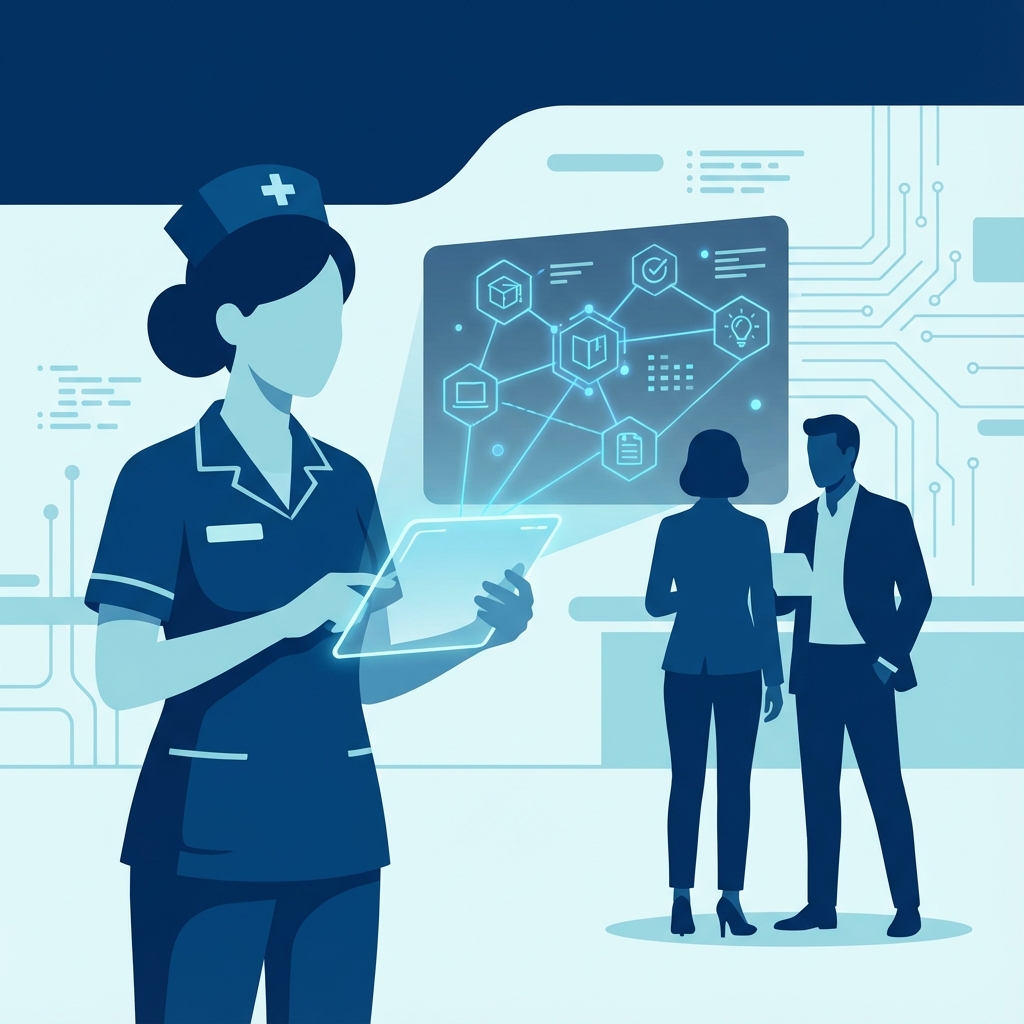
Teaching with Multimodal Gen AI
Original work: "Educators' guide to multimodal learning and Generative AI" — Tünde Varga-Atkins, Samuel Saunders, et al. (2024/25) — CC BY-NC 4.0
Adapted for UK Nursing Education by: Lincoln Gombedza, RN (LD)
Last Updated: December 2025
Generative AI (GenAI) tools significantly broaden the possibilities for multimodal teaching by enabling educators to design, adapt, and deliver content across a range of media. These technologies support not only the creation of multimodal artefacts such as images, audio, video, and interactive simulations, but also the transposition of content from one format to another.
Why This Matters for Nursing Education
For instance, GenAI might be used to:
- 📝 Convert lecture notes on diabetes management into podcasts for mobile learning
- 📊 Transform care pathway flowcharts into explanatory narratives
- 🎥 Turn seminar discussions about person-centred care into visual summaries
- 🖼️ Create anatomical diagrams from text descriptions
This ability to work fluidly across modes introduces new opportunities for nursing educators to make complex clinical concepts more tangible, and to design learning experiences that better accommodate the diversity of students' learning preferences and needs.
The Role of GenAI
In a multimodal teaching-learning environment, GenAI allows educators to move decisively beyond text-dominant approaches:
What GenAI Can Do:
- Text-to-image and text-to-video tools can generate diagrams, animations, and explanatory visuals in minutes
- Audio synthesis can create narrated explainers or podcasts to accompany slides
- Large language models can rapidly produce draft quiz questions, scenario descriptions, or alternative explanations pitched at different levels of complexity
The role of GenAI in this context is best understood as amplification rather than substitution — it does not replace the pedagogical expertise or creativity of educators, but instead augments their capacity to respond flexibly to students' needs.
Educators can focus on higher-order aspects of teaching such as sequencing, framing, and critical discussion, while delegating lower-level production tasks to AI. This shift enables more responsive and iterative teaching design.
Critical and Ethical Orientation
At the same time, embedding GenAI into multimodal teaching demands a critical and ethical orientation:
- AI-generated outputs are shaped by their training datasets — they may reproduce biases, inaccuracies, or stereotypes
- Educators have a dual responsibility:
- Model critical interrogation of AI outputs in their own teaching practice
- Scaffold students' ability to do the same
This is especially vital where AI is used to represent nursing knowledge visually or narratively, as inaccuracies can be less immediately visible than in text.
For nursing specifically:
- Verify clinical information against NICE guidelines, NMC standards, Cochrane reviews
- Check anatomical diagrams for accuracy
- Review patient scenarios for realistic and ethical representation
- Ensure cultural sensitivity in generated content
Equity and Sustainability
Considerations of equity and sustainability must also inform multimodal AI use:
- Access to high-quality AI tools is uneven across institutions and student populations
- Premium features are often gated behind paywalls
- Image and video generation carry significant computational and environmental costs
Therefore: Purposeful adoption is essential, ensuring that multimodal AI is used where it genuinely enhances learning rather than as a novelty.
Future-Facing Skills
Integrating GenAI into multimodal teaching also creates opportunities to develop future-facing skills. As healthcare increasingly demands fluency in interpreting, critiquing, and collaborating with AI-generated content, students benefit from encountering these practices within their studies.
Educators who intentionally model transparent AI use—explaining prompts, evaluating outputs, and reflecting on limitations—can nurture these literacies while simultaneously enriching disciplinary teaching.
What's in This Section?
This section explores how educators can use Generative AI (GenAI) to support and enhance multimodal teaching practices in nursing education:
1. Creating Visual Content
- Generating images for diagrams, posters, presentations
- Creating multimodal elements for infographics
- Visual metaphors for abstract concepts
- Educational videos and animated explainers
Nursing examples: Wound care diagrams, medication administration flowcharts, anatomical illustrations
2. Teaching Delivery
- AI-powered Q&A chatbots trained on course materials
- Generating multimedia lecture components
- Multimodal activity briefs with diagrams and audio
Nursing examples: Interactive patient scenario chatbots, clinical skills video demonstrations
3. Collaborative Learning
- Auto-generating ideas for brainstorming
- Supporting design thinking in group work
- Creating discussion prompts and scenarios
Nursing examples: Group care planning exercises, interprofessional collaboration scenarios
4. AI Literacy Activities
- Teaching students to critically evaluate AI outputs
- Prompt engineering practice
- Understanding AI limitations and biases
Nursing examples: Critiquing AI-generated care plans, testing AI health information accuracy
5. Benefits
- Enhancing pedagogy through diverse modalities
- Lowering barriers to multimodal creation
- Boosting creativity and idea generation
- Increasing efficiency
- Enhancing student engagement
- Preparing students for AI-augmented healthcare
6. Practical Tips
- Save time with smart AI use
- Mirror AI use: show your process
- Ethical and sustainable use checklists
- Design for human-AI collaboration
- Teach AI literacy as a core skill
7. Nursing Examples
- Anatomy & Physiology visualization
- Patient scenario generation
- Clinical skills training materials
- Person-centred language checking
- Care planning templates
Ready to explore? Start with Creating Visual Content or jump to Nursing Examples for specific use cases! 🚀